

Learning how to make friends as an adult has little to do with luck or charisma; it is a set of small, repeatable habits that put you in front of the same people often enough for real friendships to grow. This is the full system: what loneliness costs, why making friends got so hard, and the exact habits to track.
What Loneliness Does to Your Body and Mind
Loneliness is not just an uncomfortable feeling; it wears down health, mood, and careers.
- Weak social ties raise the risk of early death about as much as smoking 15 cigarettes a day.
- Chronic loneliness raises heart disease risk by about 29 percent and stroke risk by about 32 percent.
- Lonely older adults are about 50 percent more likely to develop dementia, the gradual loss of memory and thinking.
- Feeling alone keeps the body's stress system switched on, driving inflammation and higher blood pressure.
- Lonely people sleep worse because the brain stays subtly on guard without a safe social circle nearby.
- Loneliness fuels depression and anxiety, and low mood then makes reaching out even harder.
- Lonely employees are less engaged at work and around five times more likely to miss days from stress.
- People without close friends more often cope through alcohol, overeating, smoking, or impulse spending.
- Isolation cuts people off from the informal networks that lead to jobs, advice, and opportunities.
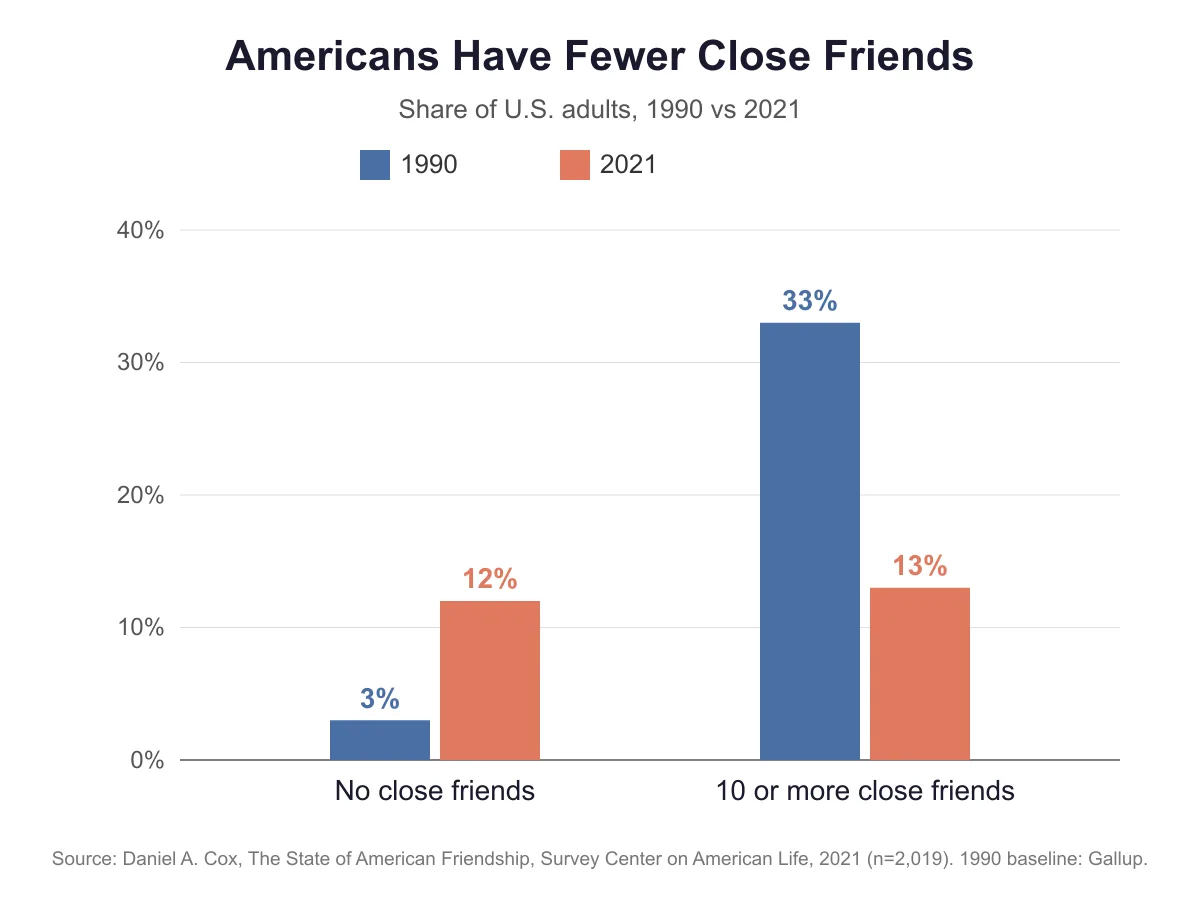
The 2021 American Perspectives Survey asked 2,019 U.S. adults how many close friends they have and compared the answers with a 1990 Gallup survey: the share with no close friends rose from 3 percent to 12 percent, while the share with 10 or more close friends fell from 33 percent to 13 percent.
Why Is It So Hard to Make Friends as an Adult?
Almost none of it is about you as a person; adult life quietly removes the conditions friendships need.
- Friend networks naturally shrink after about age 25 as work, commuting, and chores crowd out free time.
- Building a real friendship takes roughly 90 to 200 hours together, time adult routines rarely provide.
- School and university deliver built-in daily contact, and that automatic supply vanishes after graduation.
- Moving cities for work or study repeatedly cuts people off from the networks they had built.
- Remote work removes the casual daily contact with colleagues that used to spark friendships.
- Parenthood, caregiving, and long hours drain the time and energy needed to start or keep friendships.
- People consistently underestimate how much new acquaintances liked them, the so-called liking gap, so they never follow up.
- Screens and social media imitate contact but lack the real back-and-forth that builds closeness.
- Social skills fade without practice, and fear of rejection stops people from making the first move.
- Anxiety rates keep rising, and anxious people avoid the very situations where friendships start.
- Heavy porn use dulls the drive to seek real closeness and leaves many users more withdrawn.
- Hours of daily social media scrolling eat the free time that used to go into meeting people face to face.

Daily Habits to Make New Friends
Loneliness has many entry points, from a house move to fading social skills, so pick the habits that match where your connection is thinnest.
Meeting new people
HabitLanguage meetup
Meet people at a language exchange once a week
+30
Language meetup
Meet people at a language exchange once a week
Instructions: 1. Find a weekly language exchange meetup in your city, for example on Meetup or Facebook events. 2. Go and talk to people in the languages you speak or are learning. 3. Exchange contacts with someone you clicked with.
Why it may help: Language exchange meetups are full of newcomers and open people, so starting conversations feels natural and easy.
HabitSocial sports class
Go to one social sports class per week
+30
Social sports class
Go to one social sports class per week
Ideas: - Padel or tennis - Bouldering or climbing - Martial arts - Running club - Beach volleyball - Hiking group
Why it may help: Sweating together breaks the ice fast, and weekly sessions put you in front of the same people again and again.
HabitHobby workshop
Go to one social hobby workshop or class weekly
+30
Hobby workshop
Go to one social hobby workshop or class weekly
Ideas: - Salsa or bachata classes - Cooking workshop - Board game night - Book club - Improv class - Art class
Why it may help: A shared hobby gives you an instant topic and a natural reason to see the same people regularly.
HabitArt class
Join an art class once a week and chat there
+30
Art class
Join an art class once a week and chat there
Ideas: - Pottery or ceramics - Painting - Drawing or life drawing - Sculpture - Photography course
Why it may help: Creating side by side takes the pressure off talking, so conversations start on their own.
HabitGroup fitness class
Take a group fitness class at your gym weekly
+30
Group fitness class
Take a group fitness class at your gym weekly
Check which group classes your gym membership already includes. Ideas: - Yoga - Pilates - Spinning - HIIT or bootcamp - Zumba or dance fitness - Body pump
Why it may help: Regular classes turn strangers into familiar faces, and familiar faces are where friendships start.
HabitFriendship app
Meet one new person from a friendship app weekly
+50
Friendship app
Meet one new person from a friendship app weekly
Commonly used apps: - Bumble For Friends - Meetup - Timeleft
Why it may help: Apps remove the hardest step, finding people who also want new friends, so you only have to show up.
HabitGreet by name
Greet regulars by name and ask about their day
+10
Greet by name
Greet regulars by name and ask about their day
Instructions: 1. Pick a place you visit often, like the gym, work, the supermarket, or your coffee shop. 2. Greet a person there by name and ask how their day is going. 3. Listen and respond to what they say.
Why it may help: Hearing their own name makes people warm to you, and tiny repeated chats slowly build real familiarity.
HabitRemember a name
Learn one regular's name and use it next time
+12
Remember a name
Learn one regular's name and use it next time
Instructions: 1. Pick one person you see regularly but do not know yet. 2. Introduce yourself and ask their name, or listen for it. 3. Greet them by name the next time you see them.
Why it may help: Remembering a name signals genuine interest and turns an anonymous face into the start of a connection.
Deepening and keeping friendships
HabitReconnect
Reach out to someone you have lost contact with
+15
Reconnect
Reach out to someone you have lost contact with
Instructions: 1. Think of one person you liked but drifted away from. 2. Send a short, warm message and mention a shared memory. 3. Do not overthink the wording, simple and honest works. 4. If they reply, suggest a call or a coffee.
Why it may help: Old friendships restart faster than new ones because the trust is already there; one message is often enough.
HabitMessage a friend
Send one friend a short message today
+5
Message a friend
Send one friend a short message today
Instructions: 1. Pick one friend you have not talked to in a while. 2. Send a short personal message, like a memory, a question, or something that reminded you of them. 3. Reply when they answer.
Why it may help: Friendships survive on small regular contact, and one daily message keeps your ties warm with almost no effort.
HabitFacetime Check-in
Call 1 friend per week via FaceTime to catch up
+8
Facetime Check-in
Call 1 friend per week via FaceTime to catch up
Instructions: 1. Pick one friend and agree on a time to call. 2. Talk about how you are really doing, not just logistics. 3. End the call by planning the next one.
Why it may help: Seeing a face and sharing honestly builds the closeness that texts cannot, especially with friends far away.
Host a gathering
Invite people over once a month
Why it may help: Hosting makes you the connector of your circle, and mixing groups multiplies everyone's friendships, including yours.
Ask more questions
Ask more questions than you answer today
Why it may help: People bond with those who show real curiosity about them, and questions carry a conversation further than talking about yourself.
HabitNote down 1 detail
Write down 1 personal detail you learned about a friend
+5
Note down 1 detail
Write down 1 personal detail you learned about a friend
Instructions: 1. After a conversation, note one personal detail the other person shared, like their dog's name or an upcoming trip. 2. Save it in your notes app with their name. 3. Bring it up the next time you talk.
Why it may help: Remembering small details makes people feel truly heard, which sets you apart from every casual acquaintance.
Give a compliment
Give someone a genuine, specific compliment
Why it may help: A specific honest compliment brightens someone's day and makes you someone people enjoy being around.
Online connection
HabitPost an activity
Share one activity you did on social media
+8
Post an activity
Share one activity you did on social media
Instructions: 1. Do something worth sharing, like a class, a hike, or a cooking session. 2. Post it on your social media. 3. Reply to everyone who reacts or comments.
Why it may help: Sharing what you do invites others to join next time and restarts conversations with people who react.
HabitConnect online
Add one person on social media you met and start a chat
+8
Connect online
Add one person on social media you met and start a chat
Instructions: 1. Add one person you recently met on social media, only if you did not get their number. 2. Send a short message referring to where you met. 3. Keep the chat going toward a next meetup.
Why it may help: A quick follow-up locks in a new contact before the connection fades, and most people are happier to hear from you than you think.
HabitOnline community
Join one community conversation this week
+8
Online community
Join one community conversation this week
Instructions: 1. Pick a community where members actually meet or talk, like a hobby Discord with voice chats or meetups, a Meetup.com group, or a local WhatsApp or Facebook group. 2. Join one conversation this week. 3. When it fits, join or propose a real-life meetup.
Why it may help: Active communities are a low-pressure door to real meetups, because you already share an interest before you meet.
Exposure challenges
HabitExposure tier 1
Do one easy social challenge from tier 1
+40
Exposure tier 1
Do one easy social challenge from tier 1
Face the fear in small doses. Complete any one challenge today. Pick one challenge: 1. Greet a stranger. 2. Make eye contact with three people. 3. Ask a stranger for the time or for directions. 4. Make small talk with a cashier. 5. Ask a barista a question. 6. Ask a shop worker where an item is, even if you know. 7. Say hi to a neighbor and use their name. 8. Ask a colleague what they did at the weekend. 9. Order out loud instead of via app. 10. Make one phone call instead of texting. Move up to tier 2 once these stop feeling scary.
Why it may help: Tiny social dares like asking a stranger for the time build courage step by step without overwhelming you.
HabitExposure tier 2
Do one medium social challenge from tier 2
+40
Exposure tier 2
Do one medium social challenge from tier 2
Bigger asks, including some where a no is likely. Complete any one challenge today. Pick one challenge: 1. Start one conversation. 2. Compliment a stranger’s outfit, shoes, or dog. 3. Raise your hand and ask one question in class or a meeting. 4. Ask a stranger to take a photo of you. 5. Ask for a discount on a full-price item. 6. Ask a café to make you something that is not on the menu. 7. Invite an acquaintance for a coffee this week. 8. Post something publicly. 9. Ask a waiter what they would order and take their recommendation. 10. Ask a question at the end of a talk or presentation. 11. Return an item to a shop and ask for a refund. 12. Ask a neighbor to lend you something small. 13. Ask a coworker to have lunch together. 14. Tell a short funny story in a group. Move up to tier 3 once these stop feeling scary.
Why it may help: Medium challenges stretch your comfort zone once easy ones stop feeling scary, keeping progress going.
HabitExposure tier 3
Do one bold social challenge from tier 3
+40
Exposure tier 3
Do one bold social challenge from tier 3
Bold asks and small performances. Complete any one challenge today. Pick one challenge: 1. Attend one social event. 2. Ask someone in a queue if you can go ahead because you are in a hurry. 3. Ask your boss or teacher for an extension you do not strictly need. 4. Ask a bakery for a free taste of something new. 5. Haggle at a market and hold your ground after the first no. 6. Ask a stranger if you can join their table and chat for a minute. 7. Give a short toast or mini speech in front of a group. 8. Sing or dance for a moment in a public place. 9. Ask a barista to show you how the espresso machine works. 10. Go alone to a meetup or class where you know nobody. 11. Politely send back a wrong order at a restaurant. 12. Ask a question in front of a large audience. 13. Ask someone new for their number or social handle. 14. Tell a group a personal story about yourself. 15. Ask a group of strangers if you can join their game.
Why it may help: Bold challenges prove to yourself that rejection is survivable, which removes the biggest brake on making friends.
Professional support
Therapy session
Go to therapy and give it your best
Why it may help: A therapist helps you untangle the anxiety and thought patterns that keep you isolated, which makes every other habit here easier.