
If you want to know how to build confidence, the answer is not a mindset trick, it is a set of small daily habits that give you steady proof of what you can do. This is the full system: what low confidence costs, where it comes from, and the exact habits to track.
What low self esteem costs you
Low confidence is not just an uncomfortable feeling. It quietly changes decisions, relationships, and health for the worse.
- People with low confidence skip promotions, stay in jobs below their skill level, and avoid applying for roles they could win, so their careers stall.
- Constant self-doubt makes people either tolerate mistreatment in relationships or push partners away out of fear of rejection.
- Fear of judgment turns normal social situations into threats, so people avoid them and their world shrinks.
- Avoiding challenges brings short-term relief but blocks the successes that would build confidence, locking the problem in place.
- Low self-esteem is not just a symptom of depression and anxiety; long-term studies show it comes first and raises the risk of both.
- Rejection lowers self-esteem far more than acceptance raises it, so every setback hits a low-confidence person harder.
- Chronic self-doubt feeds stress that wears down physical health, and it is linked to poorer eating, less exercise, and substance use as a coping crutch.
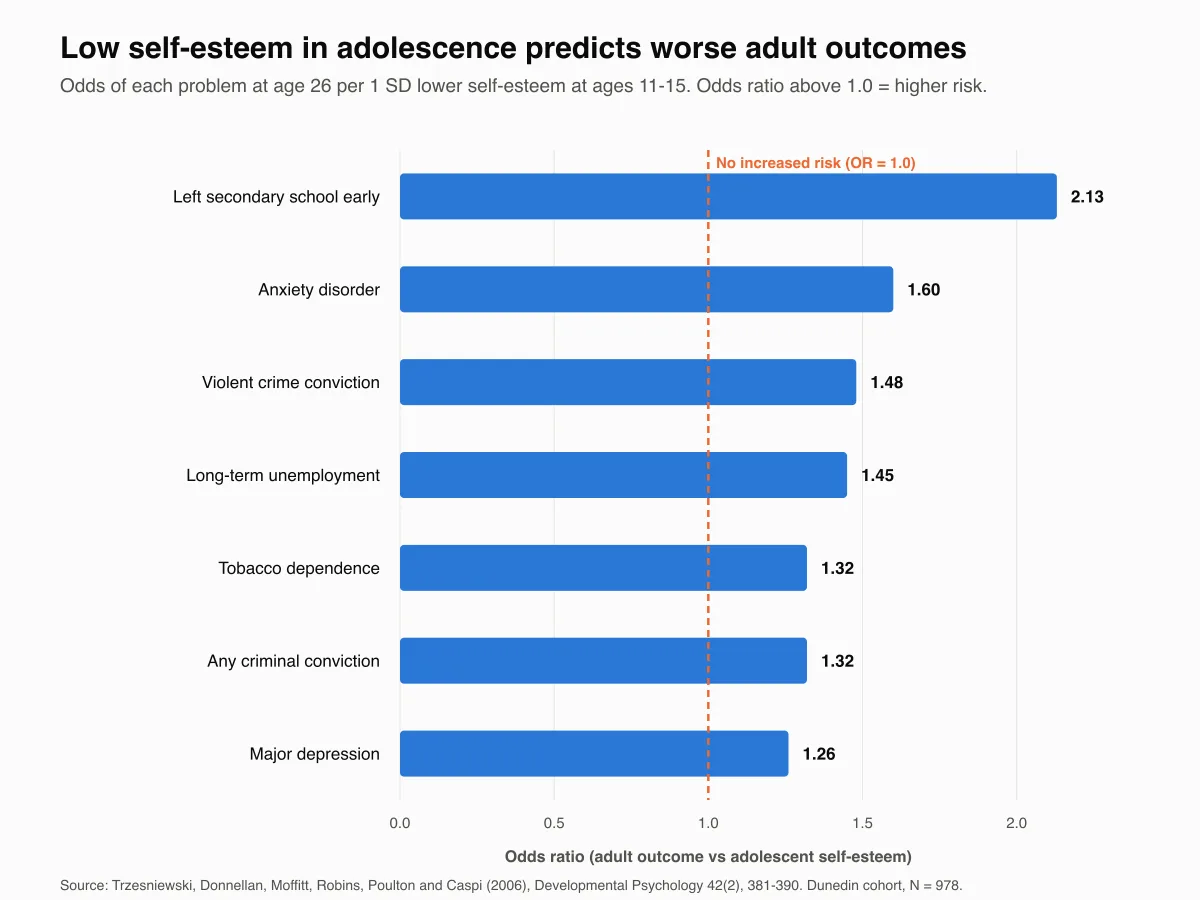
Trzesniewski and colleagues (2006) followed 978 New Zealanders from age 11 to age 26 and found that for each step down in teenage self-esteem, the odds of adult problems rose: leaving school early (2.13 times), anxiety disorder (1.60), violent crime conviction (1.48), and long-term unemployment (1.45), even after accounting for depression, gender, and family background.
Why do I have no confidence? The real causes
Low self esteem is learned, which is good news: what was learned can be retrained. These are the most common drivers.
- Childhood criticism, neglect, or being constantly compared to siblings and peers plants self-doubt that lasts into adulthood.
- Social media shows other people's filtered highlight reels, so people compare their real struggles to staged perfection and feel they fall short.
- Perfectionism makes every small mistake feel like a major failure, so nothing ever feels good enough.
- Negative self-talk works like an inner bully that repeats put-downs until self-doubt becomes automatic.
- Past rejections, bullying, or public failures create lasting shame that becomes part of how a person sees themselves.
- Lack of real skill mastery keeps confidence low, because feeling competent at concrete things is what builds a general sense of worth.
- Poor body image is a major driver and is strongly tied to low self-esteem in both men and women.
- Anxiety and low self-esteem reinforce each other, since a solid sense of worth normally acts as a buffer against worry.
- Big life hits like job loss, money problems, illness, or a breakup can knock down a previously stable sense of worth.
Daily habits to build confidence
Low confidence has different roots: harsh self-talk, avoidance, comparison, or feeling unskilled. Pick the habits below that match yours.
Mind and self-talk
HabitPower Affirmations
Read confidence affirmations out loud
+8
Power Affirmations
Read confidence affirmations out loud
Read these out loud, slowly, once each morning. Confidence affirmations: 1. I am capable of more than I give myself credit for. 2. I have handled hard things before and I can do it again. 3. I earn my own respect by keeping my word to myself. 4. I am allowed to be a beginner and still be proud. 5. My progress counts even when it is small. 6. I speak about myself the way I would about a friend. 7. I bring something to the table that no one else does. 8. A mistake is a lesson, not a verdict on me. 9. I do not need to be perfect to be valuable. 10. I grow every time I try something uncomfortable. 11. I decide my worth, not other people's opinions. 12. I can learn any skill I give real time to. 13. My body gets stronger and my mind follows. 14. I deserve the space I take up. 15. I act first and confidence follows. 16. Comparison steals nothing from me today. 17. I back myself even when the outcome is unsure. 18. Every small win today is proof of who I am becoming. 19. I trust my ability to figure things out. 20. I am building confidence one day at a time.
Why it may help: Hearing yourself state your strengths daily slowly replaces the automatic put-downs with a fairer inner voice.
HabitDaily wins log
Write down 3 things you did well today
+7
Daily wins log
Write down 3 things you did well today
Instructions: 1. At the end of the day, write down 3 things you did well, however small. 2. For each one, add a few words on what you did to make it happen. 3. Re-read the list before closing it and take a moment to feel it.
Why it may help: Collecting daily proof of what you did well builds confidence on evidence, not just positive words.
HabitMeditate
Meditate for 10 minutes using Headspace
+25
Meditate
Meditate for 10 minutes using Headspace
Benefits: - Lowers stress - Reduces anxiety - Sharpens focus - Increases self-awareness - Lowers blood pressure - Improves sleep quality - Decreases inflammation - Enhances memory
Why it may help: Regular meditation quiets the stream of self-critical thoughts and builds calm you can carry into stressful moments.
HabitNo negative self-talk
Catch negative thoughts today and be kinder to yourself
+24
No negative self-talk
Catch negative thoughts today and be kinder to yourself
Negative Effects: - Lower confidence - Reduced self-esteem - Increased anxiety - Low mood - Poor motivation - Fear of failure - Avoiding challenges - Perfectionism - Feeling hopeless - Difficulty accepting mistakes - Constant self-criticism - Comparing yourself to others - Ignoring your achievements - Social withdrawal - Feeling undeserving - Increased stress - Believing negative thoughts as facts - Difficulty recognizing progress
Why it may help: Catching put-downs in the moment stops self-doubt from running on autopilot.
Body and energy
HabitGym
Go to the gym for a full workout session
+40
Gym
Go to the gym for a full workout session
A complete session can be simple: - Warm up for 5 minutes - Do 4 to 6 main exercises - Record your weights or reps - Finish with a short cooldown
Why it may help: Getting stronger gives progress you can see and measure, and progress you earned is hard evidence against self-doubt.
HabitCold shower
Take a cold shower to boost alertness and resilience
+25
Cold shower
Take a cold shower to boost alertness and resilience
Start gradually: - Finish a normal shower with 15 to 30 seconds of cool water - Keep your breathing slow - Increase the time only when it feels manageable - Stop if you feel dizzy or unwell
Why it may help: Choosing discomfort on purpose every morning proves to yourself that you can handle hard things.
Morning sunlight
Get sunlight after waking to reset your body clock
Why it may help: Light and movement early in the day lift mood and energy, and a strong start makes the rest of the day feel more manageable.
Sleep enough
Get a full 8 hours of sleep tonight
Why it may help: A rested brain judges itself less harshly and bounces back faster from setbacks.
Presence and appearance
HabitPosture check
Stand tall with shoulders back several times a day
+5
Posture check
Stand tall with shoulders back several times a day
Instructions: 1. Set 3 reminders spread across your day. 2. At each reminder, straighten your back, pull your shoulders back and down, and lift your chin level. 3. Hold the tall posture for one minute and keep breathing normally.
Why it may help: An upright posture signals capability to others and to your own brain, which lifts mood and self-assurance.
HabitPower pose
Hold a strong open stance for 2 min before stress
+5
Power pose
Hold a strong open stance for 2 min before stress
Instructions: 1. Before a meeting, call, date, or any tense moment, find a private spot. 2. Stand with feet apart, hands on hips or arms raised, chest open. 3. Hold the pose for 2 minutes while breathing slowly and picturing the moment going well.
Why it may help: A private ritual before hard moments settles nerves and switches you into a doer mindset.
Skincare Routine
Do your skincare routine to keep your skin healthy
Why it may help: Caring for your appearance daily is a repeated signal to yourself that you are worth the effort.
HabitDress chic
Pick an outfit that makes you feel confident
+5
Dress chic
Pick an outfit that makes you feel confident
Instructions: 1. Pick an outfit that makes you look sharp and confident 2. Check fit, cleanliness, and one detail that lifts the look, like a watch or clean shoes. 3. Notice how people treat you when you look sharp: they perceive you differently, and that reflects back as confidence.
Why it may help: Looking put together changes how people respond to you and how you carry yourself all day.
Growth and focus
Learn a skill
Spend 20 minutes sharpening a work skill
Why it may help: Real competence is the most durable source of confidence, and 20 minutes a day compounds fast.
Practice hobby
Spend time on a hobby you are genuinely good at
Why it may help: Doing something you are already good at gives regular, honest proof of your own competence.
HabitNo doomscrolling
Put the phone down today to protect your time
+30
No doomscrolling
Put the phone down today to protect your time
Negative Effects: - Wasted time - Increased anxiety - Negative mood - Poor concentration - Shorter attention span - Sleep disruption - Constant comparison - Irritability - Reduced motivation - Less time for hobbies, family and friends - Headaches - Feeling disconnected from real life
Why it may help: Less scrolling means fewer chances to compare your real life to everyone else's highlight reel.
Social courage
HabitExposure tier 1
Do one easy social challenge from tier 1
+40
Exposure tier 1
Do one easy social challenge from tier 1
Face the fear in small doses. Complete any one challenge today. Pick one challenge: 1. Greet a stranger. 2. Make eye contact with three people. 3. Ask a stranger for the time or for directions. 4. Make small talk with a cashier. 5. Ask a barista a question. 6. Ask a shop worker where an item is, even if you know. 7. Say hi to a neighbor and use their name. 8. Ask a colleague what they did at the weekend. 9. Order out loud instead of via app. 10. Make one phone call instead of texting. Move up to tier 2 once these stop feeling scary.
Why it may help: Small, easy social challenges get you moving, and each one proves the fear was bigger than the reality.
HabitExposure tier 2
Do one medium social challenge from tier 2
+40
Exposure tier 2
Do one medium social challenge from tier 2
Bigger asks, including some where a no is likely. Complete any one challenge today. Pick one challenge: 1. Start one conversation. 2. Compliment a stranger’s outfit, shoes, or dog. 3. Raise your hand and ask one question in class or a meeting. 4. Ask a stranger to take a photo of you. 5. Ask for a discount on a full-price item. 6. Ask a café to make you something that is not on the menu. 7. Invite an acquaintance for a coffee this week. 8. Post something publicly. 9. Ask a waiter what they would order and take their recommendation. 10. Ask a question at the end of a talk or presentation. 11. Return an item to a shop and ask for a refund. 12. Ask a neighbor to lend you something small. 13. Ask a coworker to have lunch together. 14. Tell a short funny story in a group. Move up to tier 3 once these stop feeling scary.
Why it may help: Medium challenges stretch your comfort zone once the easy ones stop feeling scary, so progress never stalls.
HabitExposure tier 3
Do one bold social challenge from tier 3
+40
Exposure tier 3
Do one bold social challenge from tier 3
Bold asks and small performances. Complete any one challenge today. Pick one challenge: 1. Attend one social event. 2. Ask someone in a queue if you can go ahead because you are in a hurry. 3. Ask your boss or teacher for an extension you do not strictly need. 4. Ask a bakery for a free taste of something new. 5. Haggle at a market and hold your ground after the first no. 6. Ask a stranger if you can join their table and chat for a minute. 7. Give a short toast or mini speech in front of a group. 8. Sing or dance for a moment in a public place. 9. Ask a barista to show you how the espresso machine works. 10. Go alone to a meetup or class where you know nobody. 11. Politely send back a wrong order at a restaurant. 12. Ask a question in front of a large audience. 13. Ask someone new for their number or social handle. 14. Tell a group a personal story about yourself. 15. Ask a group of strangers if you can join their game.
Why it may help: Bold challenges are the final proof: once you can do these on purpose, everyday situations stop feeling like threats.