
Social anxiety is not just shyness, it is a constant fear of being judged that quietly decides where you go, what you say, and who you meet. This is the full system: why it hurts, what drives it, and the exact daily habits you can track to reduce it.
How social anxiety affects your life
The core trap is avoidance. Every skipped invitation feels like relief in the moment, but each one makes the fear stronger and your world smaller:
- Avoiding feared situations brings quick relief but makes the fear stronger next time, so the person's world slowly shrinks.
- It blocks careers because sufferers dread interviews, meetings, and presentations, so they get passed over or never apply for better roles.
- Students with it do worse in school and are less likely to finish higher education.
- It makes dating and close friendships hard, because the constant fear of being judged keeps people from opening up.
- Turning down invitations leads to loneliness and a thin support network, and loneliness then makes the anxiety worse.
- Left untreated it often adds depression on top of the original fear.
- Many people drink alcohol to get through social situations, and roughly one in five with social anxiety develop drinking problems.
- It usually starts in the teenage years and can last for decades, yet most sufferers think they are just shy and never get help.
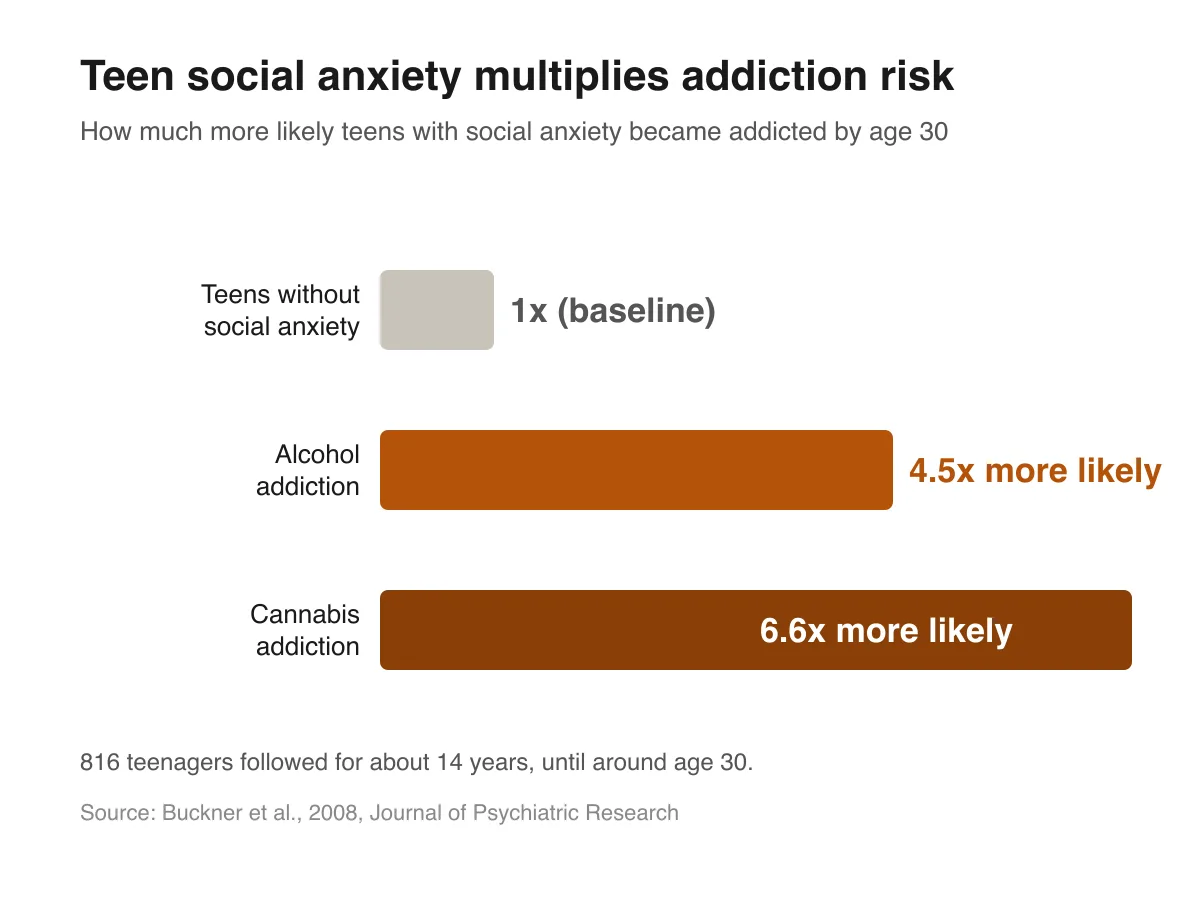
One long-term study followed 816 teenagers into their thirties and found that the teens with social anxiety were 4.5 times more likely to end up addicted to alcohol and 6.6 times more likely to end up addicted to cannabis. The anxiety was there first, which makes it an early warning sign, even if it is not the only cause.
What causes social anxiety
There is no single cause. It grows from a mix of biology, upbringing, and thinking habits, and knowing your own drivers tells you which habits below will help most:
- Overprotective, harsh, or very critical parenting can teach a child that the social world is dangerous and judgmental.
- Bullying, humiliation, or one very embarrassing moment can plant a lasting fear of being shamed again.
- The brain's alarm center, the amygdala, is oversensitive and treats neutral faces and eye contact as threats.
- At the core sits a constant fear of being judged, so every interaction gets read in the worst possible light.
- During conversations sufferers watch themselves instead of the other person, which raises anxiety and makes them seem distant.
- Safety behaviors like avoiding eye contact, rehearsing every word, or gripping a drink feel protective but stop the person from learning the situation was safe.
- After an event they replay it for hours hunting for mistakes, a habit called post-event rumination that cements the bad memory.

Daily habits to overcome social anxiety
This article is for general information only and is not medical advice. Always talk to a doctor or pharmacist before starting, stopping, or changing any medication, supplement, or treatment.
These are the habits that reduce social anxiety, from talking about it to graded exposure challenges. If you want a starting point, take the Liebowitz social anxiety test first and repeat it after a month of tracking.
Share, help, and therapy
HabitShare your anxiety
Talk about your anxiety with someone you trust
+20
Share your anxiety
Talk about your anxiety with someone you trust
Hiding anxiety feeds it. Saying it out loud makes it smaller. Instructions: 1. Pick one person you trust, or a supportive online space. 2. Tell them one honest thing about how social situations feel for you. 3. Let them respond without correcting or downplaying yourself. 4. Thank them and note how you feel afterwards.
Why it may help: Saying the fear out loud takes away the shame that keeps it alive, and support from someone you trust makes the next step easier.
Therapy session
Go to therapy and give it your best
Why it may help: A trained therapist can spot the thinking traps you cannot see yourself and guide you through them faster than trial and error.
Plan a meetup
Turn a loose plan with a friend into a date
Why it may help: Fixed plans beat vague intentions, and every meetup you actually attend proves to your brain that social time is safe.
Call your parents
Ask them how their day is going and catch up
Why it may help: A short call keeps close bonds warm and gives you easy, low-pressure speaking practice with someone on your side.
HabitReconnect
Reach out to someone you have lost contact with
+15
Reconnect
Reach out to someone you have lost contact with
Instructions: 1. Think of one person you liked but drifted away from. 2. Send a short, warm message and mention a shared memory. 3. Do not overthink the wording, simple and honest works. 4. If they reply, suggest a call or a coffee.
Why it may help: Rebuilding an old connection grows your support network with someone who already liked you once.
Breath work and meditation
Habit4-7-8 breathing
Inhale for 4, hold for 7, exhale for 8
+10
4-7-8 breathing
Inhale for 4, hold for 7, exhale for 8
Calm your body with a slow exhale: 1. Sit or lie down and rest the tip of your tongue behind your upper front teeth. 2. Breathe in quietly through your nose for 4 counts. 3. Hold your breath for 7 counts. 4. Exhale slowly through your mouth for 8 counts. 5. Repeat the cycle 4 times. Great for anxiety, stress and to fall asleep.
Why it may help: A slow exhale calms your heart rate, and a calmer heart tells your brain the situation is not dangerous.
HabitAnxiety Affirmations
Read calming affirmations for social anxiety
+8
Anxiety Affirmations
Read calming affirmations for social anxiety
Read these out loud, slowly, once each morning. Affirmations for social anxiety: 1. I am calm and at ease around other people. 2. I speak clearly and my voice deserves to be heard. 3. I am allowed to take up space in any conversation. 4. People are too busy with themselves to judge me. 5. I walk into a room expecting to be welcome. 6. A no or an awkward moment does not define me. 7. I trust myself in social situations. 8. I am interesting exactly as I am. 9. I can feel nervous and still act calmly. 10. Every social step I take makes the next one easier. 11. I do not need everyone to like me to feel good. 12. My opinion is worth sharing. 13. I look people in the eye and hold my ground. 14. Mistakes make me human, not weak. 15. I focus on the person in front of me, not on my fear. 16. It gets easier every time I say hello first. 17. I decide what my day looks like, not my anxiety. 18. Most people want me to succeed. 19. I have handled every awkward moment so far. 20. I feel calmer around people every single day.
Why it may help: Repeating confident statements each morning slowly replaces the automatic story that you are the anxious one in the room.
HabitMeditate
Meditate for 10 minutes using Headspace
+25
Meditate
Meditate for 10 minutes using Headspace
Benefits: - Lowers stress - Reduces anxiety - Sharpens focus - Increases self-awareness - Lowers blood pressure - Improves sleep quality - Decreases inflammation - Enhances memory
Why it may help: Regular meditation trains you to notice anxious thoughts without obeying them, which lowers your baseline anxiety over time.
Habit5 Senses Technique
Try the 5 senses grounding technique
+15
5 Senses Technique
Try the 5 senses grounding technique
5 senses grounding technique: - Name 5 things you can see. - Notice 4 things you can feel. - Identify 3 things you can hear. - Find 2 things you can smell. - Name 1 thing you can taste. - Take one slow breath and notice how you feel.
Why it may help: Grounding pulls your attention out of your head and into the room, which interrupts the spiral before an event.
Do CBT yourself
HabitCBT thought check
Question one anxious thought and rewrite it
+12
CBT thought check
Question one anxious thought and rewrite it
CBT (Cognitive Behavioral Therapy) is a proven method that changes how you feel by questioning what you think. Run the core loop on one anxious thought, no therapist needed. Instructions: 1. Catch one anxious thought and write it down word for word. 2. List the evidence for it and the evidence against it. 3. Ask what you would tell a friend who had this thought. 4. Write a realistic replacement thought, realistic, not just positive. 5. Act as if the realistic thought is true. Example: 1. Thought: "Everyone will notice I am nervous and think I am weird." 2. For: my hands sometimes shake. Against: nobody has ever mentioned it, and most people are too obsessed with themselves. 3. To a friend: people barely notice, they worry about themselves. 4. Realistic thought: "Some nerves may show, and that is fine, most people will not care and will rather sympathize." 5. I go to the event and let my hands do whatever they do.
Why it may help: Testing a scary thought against real evidence shrinks it, because most social fears are exaggerations that do not survive a fair trial.
HabitNo negative self-talk
Catch negative thoughts today and be kinder to yourself
+24
No negative self-talk
Catch negative thoughts today and be kinder to yourself
Negative Effects: - Lower confidence - Reduced self-esteem - Increased anxiety - Low mood - Poor motivation - Fear of failure - Avoiding challenges - Perfectionism - Feeling hopeless - Difficulty accepting mistakes - Constant self-criticism - Comparing yourself to others - Ignoring your achievements - Social withdrawal - Feeling undeserving - Increased stress - Believing negative thoughts as facts - Difficulty recognizing progress
Why it may help: Catching harsh self-judgment during the day removes the inner critic that fuels the fear of judgment from others.
HabitWorry time
Give your worries a fixed 10 to 15 minute window
+8
Worry time
Give your worries a fixed 10 to 15 minute window
A fixed window to deal with worries: 1. Pick the same 10 to 15 minutes each day, not right before bed. 2. When a worry appears outside it, note a few words and carry on. 3. During worry time, read your list and take one worry at a time. 4. If you can act on it, write down steps to act on it; if you cannot, acknowledge it and let it go. 5. Stop when the timer ends and leave the rest until tomorrow.
Why it may help: Parking worries in a fixed daily window stops them from hijacking your whole day and cuts down replaying past conversations.
The exposure challenge
HabitExposure tier 1
Do one easy social challenge from tier 1
+40
Exposure tier 1
Do one easy social challenge from tier 1
Face the fear in small doses. Complete any one challenge today. Pick one challenge: 1. Greet a stranger. 2. Make eye contact with three people. 3. Ask a stranger for the time or for directions. 4. Make small talk with a cashier. 5. Ask a barista a question. 6. Ask a shop worker where an item is, even if you know. 7. Say hi to a neighbor and use their name. 8. Ask a colleague what they did at the weekend. 9. Order out loud instead of via app. 10. Make one phone call instead of texting. Move up to tier 2 once these stop feeling scary.
Why it may help: Tiny repeated social wins teach your alarm system, through experience, that ordinary contact is safe.
HabitExposure tier 2
Do one medium social challenge from tier 2
+40
Exposure tier 2
Do one medium social challenge from tier 2
Bigger asks, including some where a no is likely. Complete any one challenge today. Pick one challenge: 1. Start one conversation. 2. Compliment a stranger’s outfit, shoes, or dog. 3. Raise your hand and ask one question in class or a meeting. 4. Ask a stranger to take a photo of you. 5. Ask for a discount on a full-price item. 6. Ask a café to make you something that is not on the menu. 7. Invite an acquaintance for a coffee this week. 8. Post something publicly. 9. Ask a waiter what they would order and take their recommendation. 10. Ask a question at the end of a talk or presentation. 11. Return an item to a shop and ask for a refund. 12. Ask a neighbor to lend you something small. 13. Ask a coworker to have lunch together. 14. Tell a short funny story in a group. Move up to tier 3 once these stop feeling scary.
Why it may help: Practicing asks where a no is possible proves that rejection stings for a moment and then nothing bad happens.
HabitExposure tier 3
Do one bold social challenge from tier 3
+40
Exposure tier 3
Do one bold social challenge from tier 3
Bold asks and small performances. Complete any one challenge today. Pick one challenge: 1. Attend one social event. 2. Ask someone in a queue if you can go ahead because you are in a hurry. 3. Ask your boss or teacher for an extension you do not strictly need. 4. Ask a bakery for a free taste of something new. 5. Haggle at a market and hold your ground after the first no. 6. Ask a stranger if you can join their table and chat for a minute. 7. Give a short toast or mini speech in front of a group. 8. Sing or dance for a moment in a public place. 9. Ask a barista to show you how the espresso machine works. 10. Go alone to a meetup or class where you know nobody. 11. Politely send back a wrong order at a restaurant. 12. Ask a question in front of a large audience. 13. Ask someone new for their number or social handle. 14. Tell a group a personal story about yourself. 15. Ask a group of strangers if you can join their game.
Why it may help: Bold challenges push your comfort zone so far that everyday situations start to feel easy by comparison.
Lifestyle
HabitGym
Go to the gym for a full workout session
+40
Gym
Go to the gym for a full workout session
A complete session can be simple: - Warm up for 5 minutes - Do 4 to 6 main exercises - Record your weights or reps - Finish with a short cooldown
Why it may help: Hard exercise burns off stress hormones, improves how you feel in your body, and builds confidence that carries into social life.
Sleep enough
Get a full 8 hours of sleep tonight
Why it may help: A rested brain reads faces and situations more calmly, while short sleep makes the alarm system jumpier.
HabitNo doomscrolling
Put the phone down today to protect your time
+30
No doomscrolling
Put the phone down today to protect your time
Negative Effects: - Wasted time - Increased anxiety - Negative mood - Poor concentration - Shorter attention span - Sleep disruption - Constant comparison - Irritability - Reduced motivation - Less time for hobbies, family and friends - Headaches - Feeling disconnected from real life
Why it may help: Less time comparing yourself to strangers online means fewer reasons to feel judged and more energy for real contact.