

The best way to learn a language is not one perfect app or method, it is a set of small daily habits that keep you studying long after motivation fades. This is the full system: what quitting costs, why is learning a language so hard for most people, and the exact habits to track.
Why Learning a Language Is So Hard for Most People
Giving up on a language is so common that it is practically the default outcome, and it costs more than most people think.
- Most people who start a language quit within their first 20 to 100 hours, long before they can hold a real conversation.
- Nearly 1 in 4 US employers has lost a business deal because their staff lacked foreign language skills.
- Bilingual employees earn more on average, with wage premiums of roughly 10 to 20% reported across several countries.
- Not speaking the local language keeps people abroad isolated; 39% of expats call the language barrier their biggest challenge.
- Quitting again and again feeds the belief "I'm just bad at languages," which makes every future attempt harder.
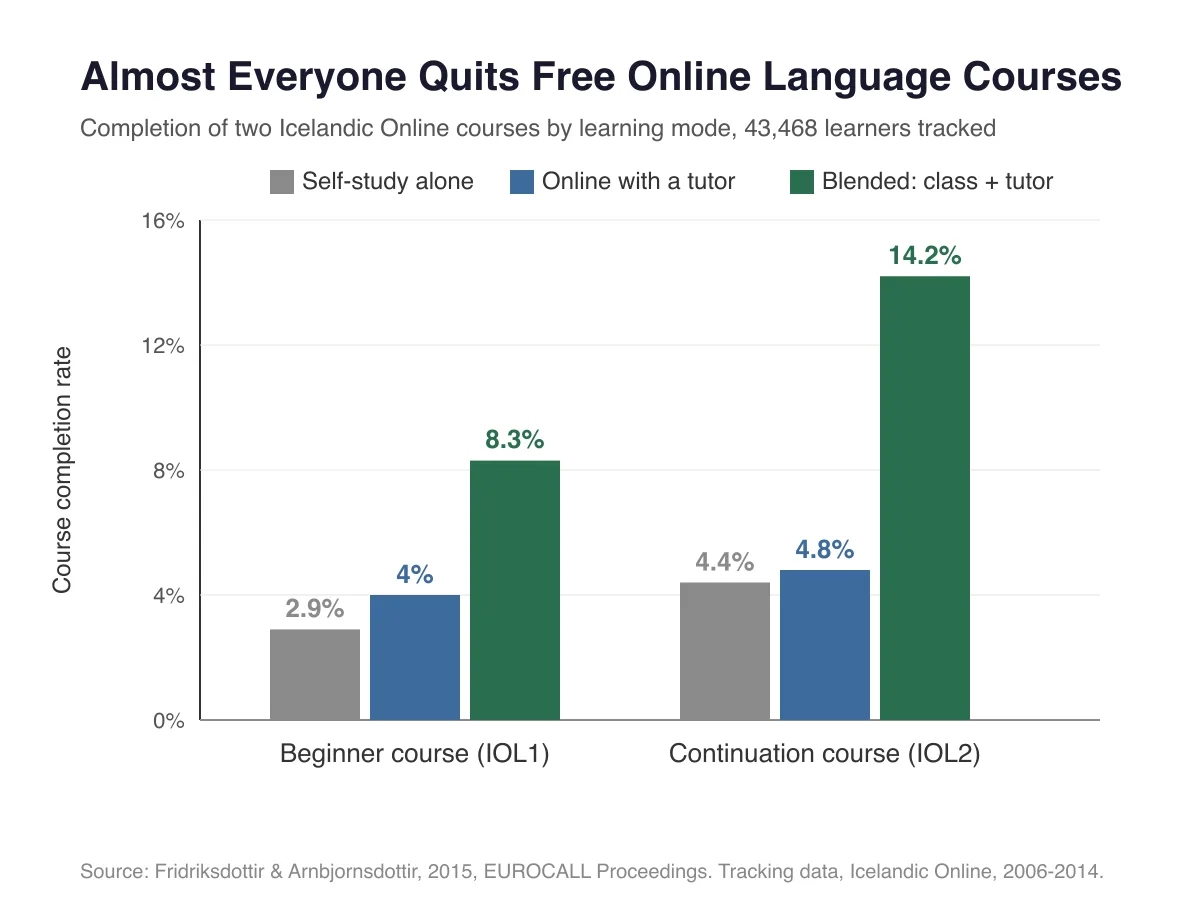
Friðriksdóttir and Arnbjörnsdóttir (2015) tracked 43,468 learners across free online Icelandic courses over eight years and found that people studying alone finished only 2.9% to 4.4% of the time, while learners in a blended course with a tutor and classes finished at 8.3% to 14.2%, roughly three times as often. Going it alone is where most people quit; support and structure sharply improve the odds.
What Makes Learning a Language So Hard
The reasons people quit are surprisingly consistent, and almost none of them are about talent.
- Lack of motivation is the most cited reason for giving up, named by 42% of learners who quit.
- People expect fluency in weeks, but an "easy" language takes about 600 study hours and a hard one over 2,200.
- Early progress is fast, then stalls at the intermediate plateau where gains stop feeling visible and many quit.
- Fear of making mistakes keeps learners silent, and without speaking practice fluency never develops.
- Studying "when there is time" instead of on a fixed daily routine is a documented failure pattern; consistency separates finishers from quitters.
- Purely passive study (tapping through app lessons, watching videos) builds recognition but never the ability to produce the language.
- Method-hopping between apps, textbooks, and courses means no single approach ever runs long enough to work.
- Nobody is watching: without a tutor, partner, or system expecting them to show up, most self-learners drift away.
- Breaks are deadly; learners who miss a full week have roughly a one-in-three chance of ever coming back.

The Best Way to Learn a Language: Small Daily Habits
People fail for different reasons: no routine, no speaking practice, or motivation that fades. The habits below cover daily input, active output, and accountability; pick the ones that match your weak spot.
HabitLearn Flashcards
Review 40 due cards and learn 5 new ones
+20
Learn Flashcards
Review 40 due cards and learn 5 new ones
App: Anki (the classic for spaced repetition), Quizlet, Memrise, or Brainscape Instructions: 1. Open Anki and review every card the app shows you today, about 40 repetitions. 2. Say each answer out loud before flipping the card. 3. Add 5 new cards from words or phrases you met recently. 4. Keep the session short and daily; never skip review days to "catch up" later. Set your daily load once in Anki: open the deck, tap the gear icon next to it, choose Options, then set "New cards/day" to 5 and "Maximum reviews/day" to 40.
Why it may help: spaced repetition shows you each word right before you would forget it, so a few minutes a day locks vocabulary into long-term memory instead of losing it.
HabitCapture new word
Add one word you needed today to your deck
+5
Capture new word
Add one word you needed today to your deck
Instructions: 1. During the day, notice one word in either language: a new word you heard in the target language, or a word from your normal day-to-day speech that you could not say in the target language. 2. Look up its meaning or translation and one example sentence. 3. Add it to your flashcard deck the same day.
Why it may help: words you actually needed come with a real situation attached, and the words you use daily in your own language are exactly the ones you will need in the new one.
HabitLanguage app lesson
Do one full lesson in your language app daily
+15
Language app lesson
Do one full lesson in your language app daily
Apps: Duolingo, Babbel, Busuu, Pimsleur, Memrise, and Language Transfer (excellent free audio courses). For Asian languages: LingoDeer (Japanese, Korean, Chinese), HelloChinese (Mandarin), WaniKani (Japanese kanji).
Why it may help: a short daily lesson keeps the streak alive on busy days and drip-feeds grammar and vocabulary in a fixed order, so you always know what to do next.
Read out loud
Read aloud in your target language for 15 min
Why it may help: reading aloud trains your mouth and ears at the same time, building speaking fluency without needing a partner or the fear of being judged.
HabitLanguage Exchange
Speak with your language exchange partner
+30
Language Exchange
Speak with your language exchange partner
Instructions: 1. Meet your exchange partner in person or on a call. 2. Spend half the time in your target language, half in theirs. 3. Ask them to correct your biggest mistakes, not every small one.
Why it may help: a real person expecting you to show up is the strongest anti-quit force there is, and real conversation is the skill every other habit is preparing you for.
HabitTutor lesson
Have a conversation lesson with your tutor
+35
Tutor lesson
Have a conversation lesson with your tutor
App: Preply, italki, Verbling, or Lingoda Instructions: 1. Book a recurring slot so the lesson defends itself in your calendar. 2. Spend most of the lesson speaking, not being lectured. 3. Ask the tutor to note your recurring mistakes and review them at the end.
Why it may help: a tutor gives corrections and structure that self-study cannot, and the booked appointment adds accountability and steady speaking practice.
Group class
Attend your weekly language class
Why it may help: a fixed weekly appointment with other learners builds routine, friendly pressure, and proof that everyone else makes mistakes too.
HabitText in the language
Chat by text with a partner in your target language
+8
Text in the language
Chat by text with a partner in your target language
What to write about: - Write about your day - Write about your favourite hobby - Write about places you want to travel to - Write about what you cooked or ate today - Write about a show, song, or game you are into right now - Write about your plans for the weekend - Ask your partner about their city, food, or traditions
Why it may help: texting is low-pressure output you can do anywhere, and it gives you time to think that live speaking does not allow.
HabitAI conversation
Talk with an AI in your target language
+30
AI conversation
Talk with an AI in your target language
Tools for talking: ChatGPT, Gemini Live, Claude Language apps built for AI conversation: TalkPal, Langua, or Speak What you can talk about: - Your day - Your hobbies - A trip you are planning - Food you love or hate - The last show or film you watched - Your work or studies - Your plans for the weekend Prompt example to start: "Speak only Spanish with me at A2 level. Keep replies short and always end with a question." Prompt example to get corrected: "Correct every mistake I make, explain it in one short sentence, then continue the conversation."
Why it may help: an AI partner is available at any hour, never judges mistakes, and adjusts to your level, which removes the two biggest excuses for not speaking.
HabitGrammar with AI
Have an AI explain, quiz, or drill one topic
+25
Grammar with AI
Have an AI explain, quiz, or drill one topic
Instructions: 1. Pick one thing that confused you today, a grammar rule, a phrase, or a word pair. 2. Ask an AI to explain it simply, for example: "Explain when to use ser vs estar like I am 12, with 5 examples." 3. Ask it to quiz you: "Now give me 10 fill-in-the-blank exercises and correct my answers."
Why it may help: an AI turns any confusion into an instant private lesson with unlimited examples and exercises, so questions get answered the day they appear instead of piling up.
HabitWrite your day
Write a short summary of your day in the language
+10
Write your day
Write a short summary of your day in the language
Instructions: 1. Write 3 to 5 sentences about your day in the target language. 2. Use only words you know; simplify instead of translating. 3. Look up at most two missing words and add them to your flashcards. 4. Let an AI correct what you wrote: paste the text into ChatGPT, Gemini, or Claude, and if it is handwritten, just take a picture of the page and drop it into the app.
Why it may help: writing about your own day forces you to produce the everyday vocabulary you will actually need in conversation.
News in language
Read or watch today’s news in your target language
Why it may help: news repeats the same core vocabulary daily and replaces a habit you already have, checking headlines, with practice time.
HabitEasy reading
Read children’s books or comics in the language
+12
Easy reading
Read children’s books or comics in the language
Instructions: 1. Choose a children’s book, comic, or graded reader below your frustration level. 2. Read a few pages, guessing unknown words from the pictures and context. 3. Only look up a word if it blocks the whole story.
Why it may help: easy, enjoyable reading gives huge amounts of comprehensible input, and finishing real books in the language is a visible, motivating win.
Language podcast
Listen to a target-language podcast on your commute
Why it may help: podcasts turn dead time into listening practice, and hearing natural rhythm daily trains your ear long before you could read at that speed.
HabitWatch an episode
One episode with target-language subtitles only
+10
Watch an episode
One episode with target-language subtitles only
Instructions: 1. Watch one episode of a series in the target language. 2. Use target-language subtitles only, never English ones. 3. Remove the subtitles as soon as you can follow without them; otherwise you train reading, not listening.
Why it may help: series deliver hours of real spoken language with a story that keeps pulling you back, so immersion happens without feeling like study.
Native YouTube
Watch a YouTube video in your target language
Why it may help: content about your own interests keeps attention high, and creators use the casual, current language textbooks never teach.
HabitMusic with lyrics
Listen to a song and follow the written lyrics
+5
Music with lyrics
Listen to a song and follow the written lyrics
Instructions: 1. Play a song in the target language and read the lyrics while listening (search them up beforehand) 2. Look up the two or three lines you like most. 3. Sing along once you know the words.
Why it may help: melody and repetition glue phrases into memory, and songs make pronunciation and rhythm practice feel like a treat instead of a task.
HabitTranslate a text
Translate a short text and check your version
+20
Translate a text
Translate a short text and check your version
Instructions: 1. Take a short paragraph in your own language and translate it into the target language. 2. Compare your version with a machine translation and note the differences. 3. Add the constructions you got wrong to your flashcards. 4. AI can help you here: paste both versions into ChatGPT, Gemini, or Claude and ask it to compare them, explain your mistakes, and show the most natural way to say it.
Why it may help: translating exposes exactly which grammar and vocabulary you are missing, turning vague weaknesses into a concrete list to fix.