A stomach ache that keeps coming back is rarely one problem with one fix, so this is the full system: what the pain costs you, what is driving it, and the exact habits and rewards you can track.
What a constant stomach ache really costs you
Recurring gut pain is easy for other people to wave away, because nothing about it shows up on a scan. The cost is real anyway, and it spreads well past your stomach:
- Ongoing stomach pain is common, not rare: around one in ten adults lives with lasting gut pain that no scan or blood test explains.
- Symptoms are unpredictable, so people carry a background worry about when the next flare will hit.
- Sleep suffers, and short nights then lower the pain threshold and make the next day worse.
- Work output drops by roughly 15 to 20 percent, and many people lose about one work day a month.
- Anxiety and low mood are far more common, and each one feeds the other in a loop.
- Many people start cutting foods out of fear, which shrinks their diet and often makes symptoms worse.
- Eating out, travel, and social plans get avoided, so the problem quietly costs friendships and fun.
- Repeated appointments and tests that find nothing leave people feeling dismissed rather than treated.
- Because nothing shows up on a scan, family and colleagues underestimate it, which adds isolation to the discomfort.
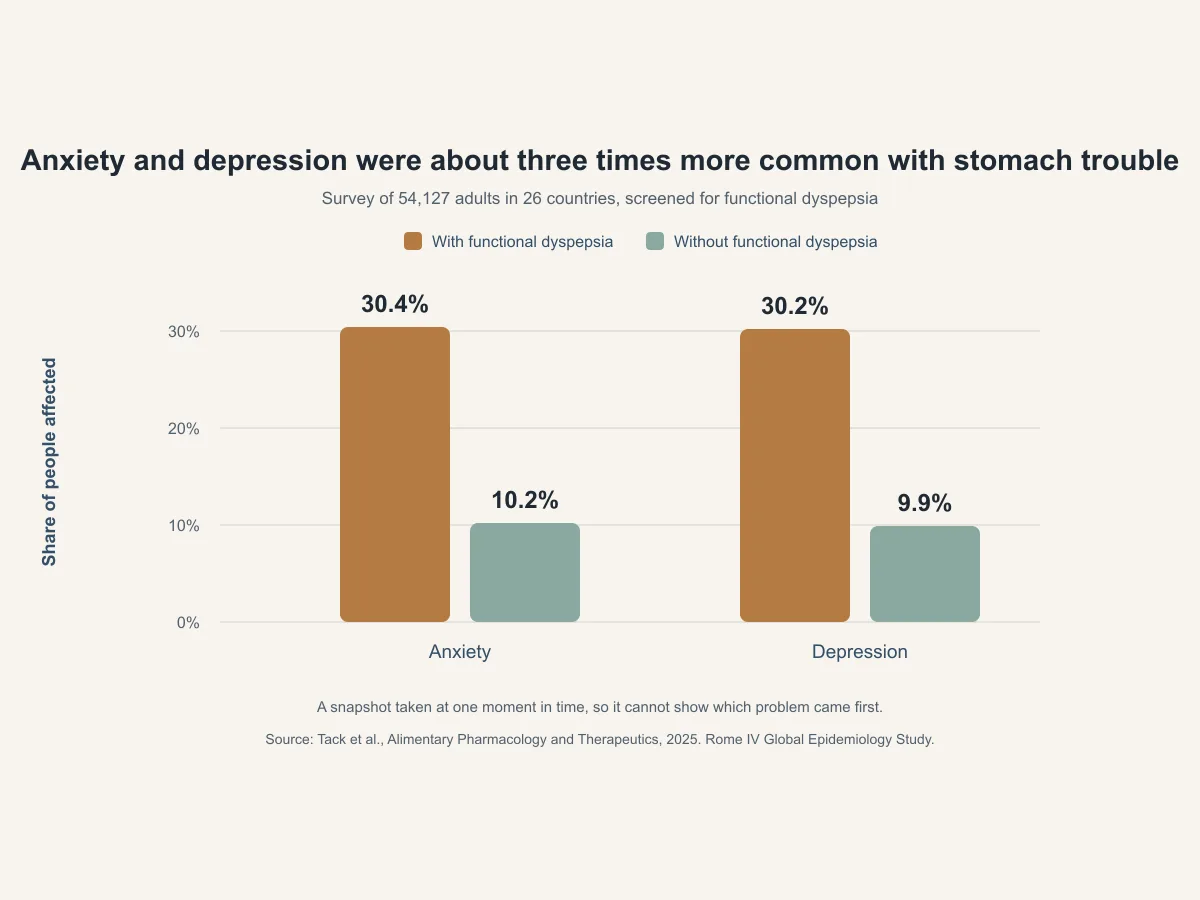
That last point has numbers behind it. A 2025 survey that screened 54,127 adults across 26 countries found anxiety in 30.4% of people with lasting upper-stomach pain against 10.2% of everyone else, and depression in 30.2% against 9.9%. It was measured at one moment, so it shows how tightly gut pain and mood travel together, not which one arrives first.
What causes stomach pain
There is no single cause, which is exactly why one person's cure does nothing for the next person. Most recurring stomach pain traces back to one of these:
Stress and the nervous system
- Stress travels straight to the gut through the nerve line connecting brain and digestion, so tension turns into cramping and nausea.
- Under stress the body slows digestion down to deal with the threat, so food sits longer than it should.
Gut bacteria, SIBO and candida
- Too many bacteria in the small intestine, called SIBO, ferment food too early and produce gas, bloating, and pressure.
- Yeast overgrowth such as candida is often blamed for bloating, though the evidence is weaker than for bacteria.
- An unbalanced mix of gut bacteria disturbs movement, gas production, and the gut lining.
- Antibiotics clear out the good bacteria along with the bad ones and leave space for the wrong ones to move in.
- Other triggers open the same door: food poisoning, acid-blocking stomach medication, too little stomach acid, a slow-moving gut, and strong painkillers.
- A diet built on bread, pasta, and sugar at the same time hands those bacteria their favourite fuel.
- Once an overgrowth exists, the carbohydrates that ferment easily only feed it, so every meal produces more gas than the last.
What you eat
- Fast food and takeaway meals are heavy in unhealthy fats and refined flour and give the gut almost nothing useful to work with.
- Most of the food sold in America is highly processed, so an unhelpful diet happens by default rather than by choice.
- Eating few vegetables starves the good bacteria of the fibre they live on, so the balance drifts.
- Too little fibre causes constipation, while a sudden jump to a lot of fibre causes gas.
- Missing the enzyme for milk sugar or reacting to gluten lets those foods ferment instead of being absorbed.
How and when you eat
- Eating fast means swallowing air and overloading the stomach before the fullness signal arrives.
- Eating late removes gravity's help, so food sits and causes reflux and overnight discomfort.
Medication, alcohol and caffeine
- Painkillers like ibuprofen and aspirin strip the mucus that shields the stomach lining from its own acid.
- Alcohol raises acid and loosens the valve at the top of the stomach, and heavy caffeine adds to the irritation.
Body and daily routine
- Sitting all day slows the gut, so food and gas linger instead of moving along.
- Short sleep lowers the pain threshold, so the same gut sensation feels sharper.
- Hormone shifts across the menstrual cycle change gut sensitivity and speed.
Habits that calm a stomach ache
This article is for general information only and is not medical advice. Always talk to a doctor or pharmacist before starting, stopping, or changing any medication, supplement, or treatment.
Stomach aches have several different causes, so the habit that fixes one person's pain does nothing for another. Try the ones that match your own pattern, track them in the app, and drop the rest.
HabitGut hypnotherapy
One guided audio session a day
+15
Gut hypnotherapy
One guided audio session a day
Instructions: 1. This is not meditation or breathwork. It is a scripted programme aimed at the gut and it runs as a fixed course. 2. Use a proper gut-directed programme such as the Nerva app or the IBS Audio Program 100. 3. Listen to one session a day, roughly fifteen to twenty minutes, with headphones somewhere quiet. 4. Lie down and let it play. There is nothing to do and nothing to get right. 5. Keep going daily for six weeks. Most people notice the change between weeks three and six.
Why it may help: A full course retrains how the brain reads the signals coming from your gut, so the same amount of gas or stretching is felt as far less pain.
HabitEat properly
Slow down, chew well, and stop before you are stuffed
+4
Eat properly
Slow down, chew well, and stop before you are stuffed
Instructions: 1. Sit down for the meal with no screen in front of you. 2. Take at least twenty minutes over it. 3. Chew every bite until it is smooth, and put the fork down in between. 4. Stop when you are about eighty percent full. 5. Keep meals at roughly the same times each day, and leave three hours between the last one and bed.
Why it may help: Eating slowly means less swallowed air and less work for the stomach, and stopping before you are full keeps it from being stretched into pain.
HabitEat an adjusted diet
Cut the foods that feed the problem, add vegetables
+25
Eat an adjusted diet
Cut the foods that feed the problem, add vegetables
Instructions: 1. Swap one meal a day for a low-FODMAP recipe. 2. Skip alcohol, caffeine, and fizzy drinks. 3. Leave out fast food and ultra-processed food. 4. Keep added sugar low. 5. Eat at least 300 g of vegetables across the day. 6. Drink two litres of water, warm or hot if that sits better, between meals rather than with them. 7. Stay smoke and vape free.
Why it may help: Cutting the foods that ferment easily starves an overgrowth, and vegetables feed the bacteria you want to keep. Nicotine loosens the valve at the top of the stomach, so leaving it out stops acid coming back up.
HabitHomemade kefir
Ferment milk kefir and eat a portion every day
+12
Homemade kefir
Ferment milk kefir and eat a portion every day
Instructions: 1. Put your kefir grains in a clean glass jar and cover them with about 500 ml of whole milk. 2. Cover the jar with a cloth or a loose lid and leave it at room temperature for 24 hours, away from direct sunlight. 3. Strain the finished kefir through a plastic colander into a glass or bottle. Never use metal, it damages the grains. 4. Put the grains straight into a fresh jar of milk to start the next batch. 5. Enjoy it your way: eat it plain with a spoon, blend it with fruit into a smoothie, pour it over oats or granola, or use it instead of yogurt in a bowl. Benefits: 1. Homemade kefir holds 60 to 110+ different live cultures, while store-bought usually has only 1 to 13. 2. The live cultures crowd out the gut bacteria that produce gas, so bloating and cramping ease off. 3. A balanced gut breaks food down properly, so you absorb more of the nutrients you eat. 4. Most of the immune system sits in the gut wall, so a healthier gut means fewer infections. 5. The gut makes most of the body's serotonin, so a calmer gut supports mood, energy, and sleep. 6. Less gut inflammation often shows on the outside too, in clearer skin.
Why it may help: Kefir tops up the gut with a wide mix of live bacteria that crowd out the ones producing the gas, and the fermentation removes most of the milk sugar, so even sensitive stomachs usually handle it well.
HabitKetogenic diet
Low carb, built on healthy fats, with electrolytes
+25
Ketogenic diet
Low carb, built on healthy fats, with electrolytes
Instructions: 1. Keep carbohydrates under roughly 30 g for the whole day, so no bread, pasta, rice, potatoes, or sugar. 2. Get most of your energy from healthy fats: olive oil, avocado, oily fish, nuts, and butter from grass-fed cows. Go easy on fried food and processed meat. 3. Add protein from meat, fish, eggs, and cheese, plus low-carb vegetables at every meal. 4. Take an electrolyte supplement daily, or salt your food properly and add magnesium and potassium. 5. Get your blood tested every six months to check cholesterol, liver values, and vitamin levels.
Why it may help: Almost no fermentable carbohydrate reaches the gut, so bacteria and yeast that live on sugar have far less to work with.
Cook at home
Cook at home to eat better and save money
Why it may help: Cooking for yourself is the only reliable way to know what is in the meal, which keeps out the additives and refined flour that irritate the gut.
HabitSpace your meals
Four hours between meals, nothing in between
+3
Space your meals
Four hours between meals, nothing in between
Instructions: 1. Leave at least four hours between the end of one meal and the start of the next. 2. In the gap drink only water, plain tea, or black coffee. 3. Aim for three real meals a day instead of grazing. 4. Leave twelve hours between dinner and breakfast.
Why it may help: Between meals the gut runs a cleaning wave that sweeps leftovers and bacteria out of the small intestine. It only runs on an empty stomach, so constant eating switches it off.
No snacking
Avoid snacking between meals
Why it may help: Every snack restarts digestion and cancels the gap the gut needs to clear itself, so grazing keeps an overgrowth fed all day.
HabitTea or hot water
A warm drink after your meal, plain or brewed
+3
Tea or hot water
A warm drink after your meal, plain or brewed
Instructions: 1. Boil water and let it cool for a minute. 2. Drink it plain, or brew chamomile, fennel, or peppermint. 3. Have one after your main meal. 4. Make another whenever your stomach feels tight or bloated.
Why it may help: Warm liquid relaxes the stomach and helps trapped gas move on, and chamomile, fennel, and peppermint each calm cramping on top of that.
HabitWalk after eating
10 min on your feet once the meal is done
+8
Walk after eating
10 min on your feet once the meal is done
Instructions: 1. Stand up within a few minutes of finishing your meal. 2. Walk at an easy, comfortable pace for ten minutes. 3. Keep it gentle, this is not a workout.
Why it may help: A short walk moves the meal out of the stomach faster, so there is less heaviness, bloating, and reflux afterwards.
HabitHeat on the belly
Twenty minutes with a heat pack on your stomach
+4
Heat on the belly
Twenty minutes with a heat pack on your stomach
Instructions: 1. Fill a hot water bottle or warm up an electric heat pad. 2. Lie down and rest it on your stomach. 3. Leave it there for about twenty minutes, or as long as the cramping lasts. 4. While it rests there, breathe deeply and slowly. Push your belly out against the pack as you breathe in, then let a long, slow breath out.
Why it may help: Warmth relaxes the muscle wall of the gut, which loosens a cramp and dulls the pain while it passes. The slow breathing adds to it by putting the body into rest and digest mode.
HabitHeal the vagus nerve
Do one exercise a day
+5
Heal the vagus nerve
Do one exercise a day
Instructions: 1. Hum, sing, or chant for a few minutes. 2. Gargle a glass of water loudly, until your eyes water. 3. Splash cold water on your face, or hold something cold over your eyes and cheeks for thirty seconds. 4. Breathe out for twice as long as you breathe in, for two minutes. 5. Massage the shell of your ear and the muscle behind your jaw. 6. Finish your shower with thirty seconds of cold water. 7. Watch something funny and laugh properly for ten minutes. 8. Lie down with your hands behind your head and look far to one side until you sigh or yawn, then do the other side. 9. Tilt your head slowly to each shoulder and hold it there while you breathe. 10. Have one long, unhurried conversation with someone you like. 11. Do a few minutes of loving-kindness meditation, wishing yourself and others well. 12. Pick whichever one suits the day. One is enough.
Why it may help: The vagus nerve carries the calm signal from the brain down to the gut, so waking it up daily settles cramping, moves digestion along, and lowers the stress feeding both.
HabitDeep Belly Breathing
5 minutes of deep belly breathing
+6
Deep Belly Breathing
5 minutes of deep belly breathing
Deep belly breathing: - Breathe in slowly through your nose, letting your belly rise. - Exhale gently through your mouth and repeat for 2 to 5 minutes. Benefits: - reduce stress - calm the nervous system - improve focus - make it easier to fall asleep - help with stomach ache
Why it may help: Slow breathing from the belly switches the body into rest and digest mode, where the gut relaxes and cramping eases off.
HabitMeditate
Meditate for 10 minutes using Headspace
+25
Meditate
Meditate for 10 minutes using Headspace
Benefits: - Lowers stress - Reduces anxiety - Sharpens focus - Increases self-awareness - Lowers blood pressure - Improves sleep quality - Decreases inflammation - Enhances memory
Why it may help: Regular meditation turns down how loudly the brain reports gut sensations, so the same amount of gas or stretching hurts less.
HabitWorry time
Give your worries a fixed 10 to 15 minute window
+8
Worry time
Give your worries a fixed 10 to 15 minute window
A fixed window to deal with worries: 1. Pick the same 10 to 15 minutes each day, not right before bed. 2. When a worry appears outside it, note a few words and carry on. 3. During worry time, read your list and take one worry at a time. 4. If you can act on it, write down steps to act on it; if you cannot, acknowledge it and let it go. 5. Stop when the timer ends and leave the rest until tomorrow.
Why it may help: Giving worries one fixed slot stops them circling all evening, which keeps the stress signal out of your stomach at night.
HabitVinegar before meals
A spoon of apple cider vinegar before you eat
+3
Vinegar before meals
A spoon of apple cider vinegar before you eat
Instructions: 1. Stir one tablespoon of apple cider vinegar into a small glass of water. 2. Drink it about ten minutes before your main meal. 3. Rinse your mouth with plain water afterwards to protect your teeth.
Why it may help: A more acidic stomach breaks food down properly instead of letting it sit and ferment, which is where the bloating and heaviness come from.
HabitL-glutamine
One daily dose for the gut lining
+3
L-glutamine
One daily dose for the gut lining
Instructions: 1. Stir 5 g of L-glutamine powder into water. 2. Take it on an empty stomach, either first thing or before bed. 3. Keep it up daily. It works over weeks rather than days.
Why it may help: Glutamine is the main fuel for the cells lining the gut, so a steady supply supports the barrier that keeps irritation out.
HabitMagnesium at night
Take magnesium before bed
+3
Magnesium at night
Take magnesium before bed
Instructions: 1. Take 200 to 400 mg of magnesium citrate or magnesium glycinate. 2. Swallow it with water about an hour before bed. 3. Drop the dose if your stools get too loose.
Why it may help: Magnesium relaxes muscle, including the wall of the gut, and pulls water into the bowel, so a stalled and cramping gut moves more easily overnight.
HabitPeppermint oil
One enteric-coated capsule before meals
+3
Peppermint oil
One enteric-coated capsule before meals
Instructions: 1. Buy enteric-coated capsules, so the capsule opens in the intestine and not in the stomach. 2. Take one with water thirty to sixty minutes before a meal. 3. Swallow it whole. Never chew it or open it. 4. Up to three capsules a day, for two to four weeks at a time. 5. Stop if it gives you heartburn, and skip it entirely if you already have reflux.
Why it may help: Peppermint oil relaxes the muscle wall of the gut, and the enteric coating carries it past the stomach so it is released where the cramping actually happens.
Cardio
Do a cardio session to get your heart pumping
Why it may help: Moving your body keeps food and gas travelling through the gut instead of sitting still and building pressure.
Walk 10K Steps
Why it may help: A day spent on your feet keeps the gut moving, so food and gas travel on instead of sitting still and building pressure.
Rewards to spend your coins on
These rewards are gentle on a sore stomach, and each one gives you a real break from the pressure that keeps the gut tense.
Massage
Book yourself a relaxing massage
Why it may help: An hour of being looked after lowers the stress load that keeps your gut tight.
Sauna session
Sweat it out and relax in the sauna
Why it may help: Heat and quiet time relax the whole body, including the muscle wall of the gut.
Spa day
Book a full spa day and unwind completely
Why it may help: A whole day off duty is a real break from the pressure that feeds stomach pain.
Sit in the sun
Relax outside in the sunshine, no exercise needed
Why it may help: Time outdoors with nothing to achieve lowers stress, and lower stress means a quieter gut.