Learning how to save money is less about willpower and more about a handful of small habits you repeat every week until they run on their own.
The Real Cost of Having No Savings
Living without a buffer is expensive in ways that go far beyond the missing balance. Here is what the numbers say:
- About 59% of Americans could not cover a surprise $1,000 bill like a car repair from savings.
- Nearly half of people hit with a $1,000 emergency put it on a credit card and pay interest on top.
- One emergency without a buffer can start a debt spiral, where interest on last month's crisis eats the money needed this month.
- Money is one of the biggest sources of stress, and 56% of employees say money worries hurt their sleep.
- No savings traps people in bad jobs and bad deals, because they cannot afford even a short gap between paychecks or walk away from an unfair offer.
- Every year without saving is a compounding loss, since money set aside early can multiply many times before retirement.
- Big goals like a home, a family, or a career change get delayed or dropped because there is no buffer or down payment.
- Money worry strains relationships, and 76% of people say they feel alone in their money struggles.
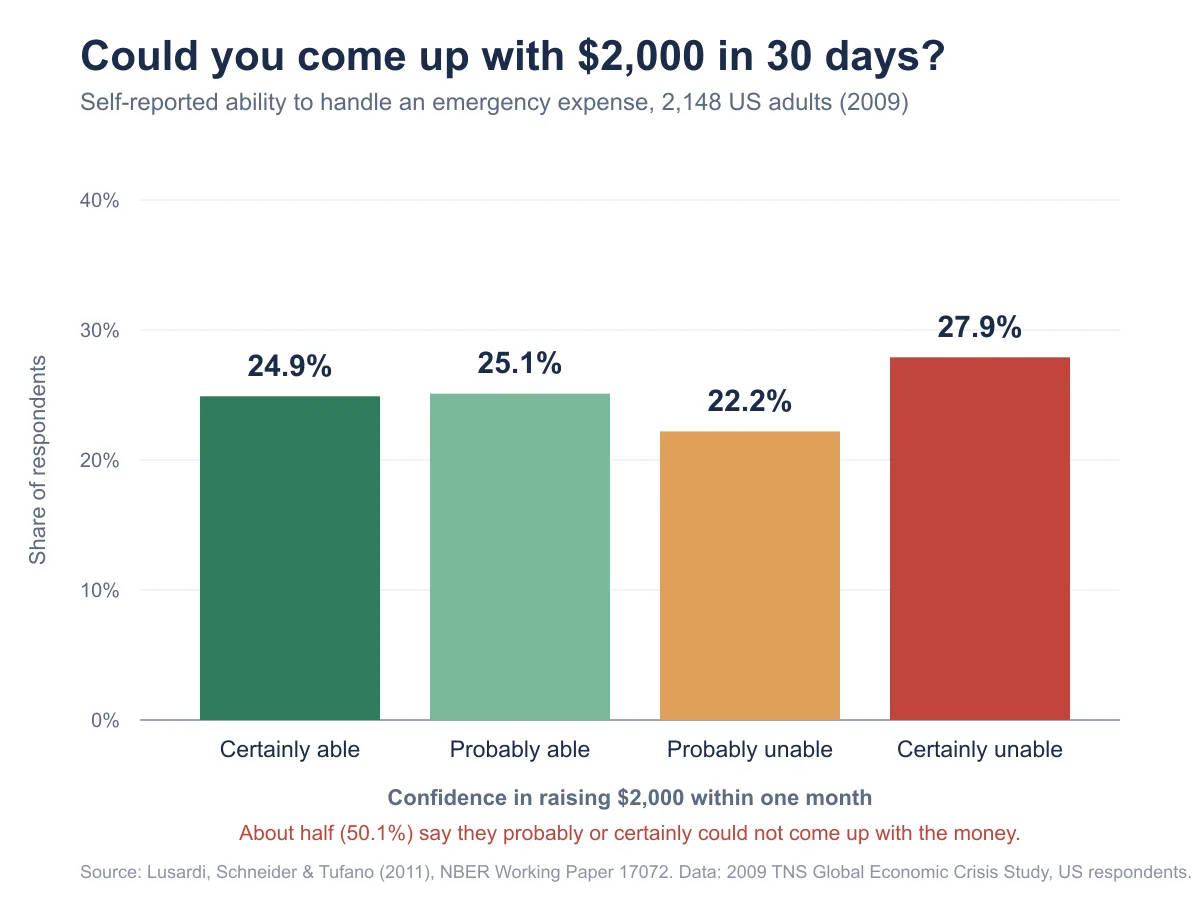
When researchers asked 2,148 US adults whether they could come up with $2,000 within a month, 50.1% answered they probably or certainly could not (Lusardi, Schneider and Tufano, 2011).
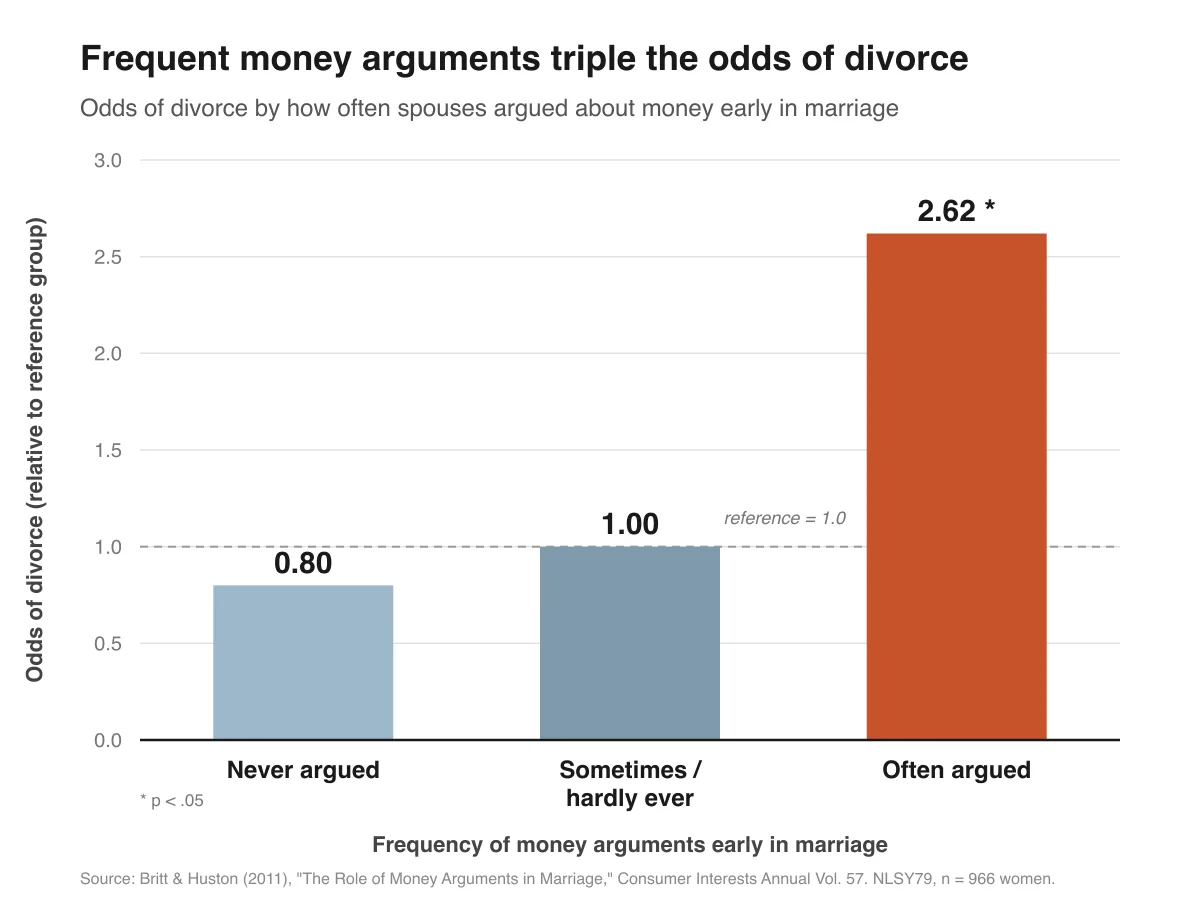
Money trouble follows people home, too. A study of 966 married women found that couples who often argued about money early in marriage had 2.62 times the odds of divorce, while arguments about other topics did not predict divorce at all (Britt and Huston, 2011).
The Traps That Keep You From Saving Money
If you keep wondering why you can't save money, the answer is usually one of these traps rather than a character flaw:
- Present bias: the brain overweights rewards it can enjoy right now, so spending today feels better than a distant savings goal.
- Without an automatic transfer, saving depends on monthly willpower to set aside whatever is left, and usually nothing is left.
- Lifestyle inflation: spending quietly rises every time income rises, so raises get absorbed instead of saved.
- Tap-to-pay and one-click checkout remove the small pain of handing over cash, so purchases feel free and add up invisibly.
- Forgotten subscriptions and memberships pull money out every month for things people barely use.
- Buy now, pay later normalizes buying things people cannot afford, and the mere option to split payments triggers extra spending.
- Social media floods feeds with other people's purchases, manufacturing wants and making ordinary life feel inadequate.
- The payday effect: spending spikes right after money lands, then the account runs dry before the next check.
- Windfalls like bonuses and tax refunds get labeled fun money in the mind, so they are spent instead of saved.
- Stagnant wages against rising rent, food, and bills leave some households with little real margin after essentials.
Download the Free Expense Tracker (Excel and Google Sheets)
Two of the habits below, logging every expense and the weekly budget check, get much easier with our free expense tracker. It has one tab per month for logging income, expenses, savings, and purchases you resisted, plus an overview tab that charts the year for you. Grab whichever version fits your life; both are free, with no email and no signup.
| Google Sheets | Excel | |
|---|---|---|
| How to use | Open the link, go to File, then choose Make a copy to save it to your Drive. | Open the link, go to File, then choose Download to get the .xlsx file. |
| Download 2026 | Download 2026 | Download 2026 |
| Download 2027 | Download 2027 | Download 2027 |
Daily Money Saving Habits to Build a Nest Egg
This article is for general information only and is not financial advice. Consider talking to a qualified financial adviser before making decisions about your money.
People fail to save for different reasons, from impulse spending to bills that are simply too high, so pick the money saving habits below that match your traps.
HabitLog expenses
Write down every expense the same day it happens
+10
Log expenses
Write down every expense the same day it happens
Instructions: 1. Pick one place to log expenses, like our free Accounting sheet, a notes app, or a small notebook. 2. Each time you pay for something, write the amount and what it was. 3. Before bed, check the day is complete and add anything you missed. Note: Use our free Expense Tracker from this blog post: https://spendyourhabits.com/blog/how-to-save-money to easily track your income, savings and expenses. Perfect for keeping an eye on your spending and doing weekly budget checks.
Why it may help: Seeing every purchase written down makes spending feel real again, and most people quietly spend less once they watch their own numbers.
HabitWeekly budget check
Review the week's spending against your budget
+30
Weekly budget check
Review the week's spending against your budget
Instructions: 1. Once a week, open your budget or the free Accounting sheet. 2. Compare what you actually spent with what you planned per category. 3. Decide one adjustment for the coming week and write it down. Note: Use our free Expense Tracker from this blog post: https://spendyourhabits.com/blog/how-to-save-money to easily track your income, savings and expenses. Perfect for keeping an eye on your spending and doing weekly budget checks.
Why it may help: A weekly look at plan versus reality catches overspending after days instead of months, so small corrections keep the budget on track.
HabitCheaper option
Had to buy it anyway, chose a cheaper option
+15
Cheaper option
Had to buy it anyway, chose a cheaper option
Instructions: 1. When you must buy something you genuinely need, pause before taking the usual one. 2. Compare a cheaper alternative, a store brand, a smaller size, or another shop. 3. Buy the cheaper option and note the difference you saved.
Why it may help: Necessary purchases cannot be skipped, but choosing a cheaper version of the same need turns every unavoidable expense into a small saving.
HabitSell old items
Sell one piece of clothing or an unused item
+35
Sell old items
Sell one piece of clothing or an unused item
Instructions: 1. Pick one item you no longer wear or use. 2. List it on a resale app or marketplace with a photo and fair price. 3. Put the money from every sale into your savings account. Photo tips: - Use a white background - Shoot in natural sunlight - Use a high quality, sharp camera lens
Why it may help: Unused things around the house are frozen money, and selling them both funds your savings and clears out clutter.
HabitFree Activity
Swap one paid outing for a free activity this week
+25
Free Activity
Swap one paid outing for a free activity this week
Pick one paid outing you would normally have this week and replace it with a free one. Ideas: 1. A hike 2. A picnic 3. A free museum day 4. A game night 5. A bike ride 6. A library visit 7. A free city walking tour 8. A home movie night
Why it may help: Fun spending is one of the easiest budgets to trim, and a planned free swap keeps the enjoyment while cutting the cost.
HabitResist the purchase
Beat a buying urge with a wait rule (1 = 1 urge resisted)
+15
Resist the purchase
Beat a buying urge with a wait rule (1 = 1 urge resisted)
Instructions: 1. When you want something that is not essential, do not buy it right away. 2. Add it to a wishlist and wait at least 24 hours. 3. Review the wishlist once a week and delete what no longer tempts you. 4. When you skip a buy for good, note down how much you saved by resisting the urge. 5. Every time you legitimately resisted the urge check this habit off to get bonus coins Note: Use our free Expense Tracker from this blog post: https://spendyourhabits.com/blog/how-to-save-money to track the amount of money you saved by not purchasing that item.
Why it may help: Most buying urges fade within a day, so parking the item on a wishlist filters out regret buys, and saving the skipped price turns every resisted urge into visible progress.
HabitNo-spend day
Go a full day without spending anything
+25
No-spend day
Go a full day without spending anything
Services / Things you can save on: - Coffee - Snacks - Takeaway - Impulse purchases - New clothes - Beauty products
Why it may help: A full day without spending resets the habit of constant small purchases and shows you how much of your spending is optional.
HabitSkip a small buy
Skip one small daily purchase and save its price
+15
Skip a small buy
Skip one small daily purchase and save its price
Instructions: 1. Pick one small purchase you would normally make today, a coffee, snack, or delivery fee. 2. Skip it and note what it would have cost. 3. Move that amount to your savings account, today or in your weekly sweep. Note: Use our free Expense Tracker from this blog post: https://spendyourhabits.com/blog/how-to-save-money to track the amount of money you saved by not purchasing that item.
Why it may help: Small daily purchases are the most common money leak, and saving the exact price of a skipped one makes the win concrete instead of letting it disappear.
HabitSweep to savings
Move the money you didn't spend into savings weekly
+25
Sweep to savings
Move the money you didn't spend into savings weekly
Instructions: 1. During the week, note every purchase you skipped and what it would have cost. 2. Once a week, add those amounts up. 3. Transfer the total into your savings account in one go.
Why it may help: A weekly transfer turns scattered small wins into one visible deposit, so your restraint shows up as a growing savings balance instead of vanishing into everyday spending.
Meal prep
Prep your meals for the week
Why it may help: Ready meals in the fridge remove the weekday excuse for expensive takeaway and lunches out.
HabitPack lunch
Bring lunch from home to save money
+22
Pack lunch
Bring lunch from home to save money
Lunch Ideas: - Chicken wrap - Tuna sandwich - Pasta salad - Poke rice bowl - Egg salad sandwich - Hummus with veggies - Leftover dinner - Couscous salad - Bean burrito - Peanut butter and banana sandwich - Quinoa bowl
Why it may help: A packed lunch costs a fraction of a bought one, and the saving repeats every single workday.
HabitCoffee at home
Make your coffee at home instead of buying out
+5
Coffee at home
Make your coffee at home instead of buying out
Instructions: 1. Prepare your coffee at home before you leave. 2. Take it with you in a travel mug. 3. Walk past the café knowing you already have yours.
Why it may help: Bought coffee is one of the most frequent small leaks, and replacing it daily saves a surprising amount over a month.
Cook at home
Cook at home to eat better and save money
Why it may help: Replacing one delivery order with a home-cooked meal saves the markup, the fees, and the tip in one move.
HabitWalk or cycle
Walk or bike instead of taking the car or a taxi
+15
Walk or cycle
Walk or bike instead of taking the car or a taxi
Instructions: 1. For short trips, choose walking or the bike first. 2. Save the car or taxi for distances that genuinely need it. 3. Track what the skipped rides would have cost. Note: Use our free Expense Tracker from this blog post: https://spendyourhabits.com/blog/how-to-save-money to track the amount of money you saved by not paying the usual gas fee or taxi fee.
Why it may help: Short rides are the most expensive per kilometre, and swapping them for your own legs saves money while adding free exercise.