

Learning how to improve concentration is less about willpower and more about a set of small daily habits that remove distractions and retrain your attention span.
What a short attention span does to your day
Weak focus is not a small annoyance. It quietly taxes every hour of your day:
- Simple tasks take far longer because the mind keeps drifting and you have to start over.
- After one interruption it takes about 25 minutes on average to get fully back into the task.
- Careless mistakes creep in, like typos, wrong numbers, and missed steps someone later has to fix.
- Reading stops working, so you reread the same line again and again without taking it in.
- Half-finished tasks pile up, and the mental clutter of open loops adds stress and worry.
- Feeling busy all day yet finishing little drains motivation and chips away at self-confidence.
- Missed deadlines and weak output can cost raises, trust, or the job itself.
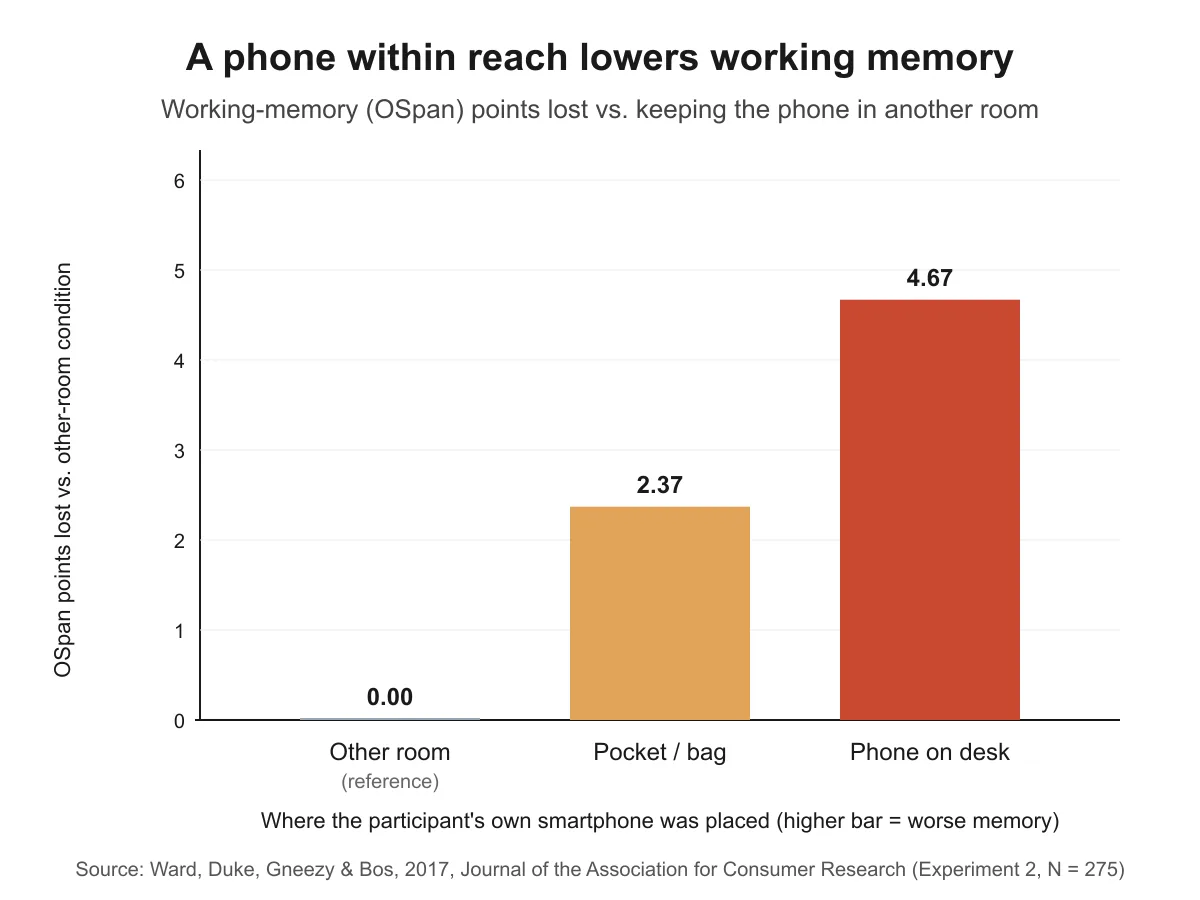
A study of 275 people found that participants whose phone lay on the desk scored 4.67 working memory points lower than those whose phone was in another room, even though nobody touched their phone. Working memory is the mental workspace you think with, and a phone within reach quietly drains it.
Why your attention span is so short
Poor focus almost always has a cause, and often more than one:
- Too little sleep leaves the brain foggy and unable to hold attention for long.
- Constant alerts pull your eyes away every few minutes and reset your train of thought.
- Trying to do several things at once splits attention, and the brain can only truly focus on one demanding thing at a time.
- Ongoing stress and anxiety fill the mind with worries that crowd out the task in front of you.
- Quick rewards from apps like social media, netflix and dating apps train the brain to crave novelty, so slow tasks feel unbearable.
- Skipping meals or eating lots of sugar causes energy crashes that scatter attention.
- Sitting all day with little exercise reduces blood flow to the brain and dulls alertness.
- Noisy, cluttered surroundings give the mind too many things competing for attention.
- Long stretches without breaks exhaust the mind, so focus fades as fatigue builds.
- ADHD, a brain condition that makes holding attention hard, causes lasting trouble staying on task.
- Depression, thyroid problems, low iron, and some medicines can quietly sap mental sharpness.

Daily habits that improve focus
This article is for general information only and is not medical advice. Always talk to a doctor or pharmacist before starting, stopping, or changing any medication, supplement, or treatment.
Pick the habits below that match your situation and build them one at a time.
Work habits that protect your focus
Plan tomorrow
Write a to-do list & pick top 3 tasks

Why it may help: A clear plan with small tasks removes decision-making during the day, so you can drop straight into work.
Hardest task first
Start the day with your most demanding task
Why it may help: Willpower and focus are strongest early in the day, so the most demanding task gets your best hours.
No phone after wake
Skip the phone for the first hour of your day
Why it may help: Starting the day without quick dopamine hits keeps your brain calm and ready for slow, demanding work.
Phone in other room
Leave your phone in another room while you work
Why it may help: A phone within reach drains thinking capacity even when you never touch it, so distance gives your brain its full power back.
HabitPomodoro session
Work in 25 min sprints with 5 min breaks
+50
Pomodoro session
Work in 25 min sprints with 5 min breaks
Instructions: 1. Pick one task and set a timer for 25 minutes. 2. Work on only that task until the timer rings. 3. Take a 5 minute break, then repeat; after 6 rounds take a longer break of 20 to 30 minutes. 4. Once 25 minutes feels easy, try one long 90 minute cycle with a 20 to 30 minute recovery instead.
Why it may help: Short timed sprints make starting easier, and the built-in breaks stop fatigue before focus collapses. Longer 90 minute cycles ride the body's natural energy wave once your focus is trained.
HabitBody doubling
Work silently alongside another focused person
+15
Body doubling
Work silently alongside another focused person
Instructions: 1. Arrange to work next to a friend or colleague, or join an online "study with me" video session. 2. Working in a library, study hall, or busy cafe works too; other focused people around you have the same effect. 3. Agree to work silently on your own tasks for a set block of time. 4. Take breaks together, then return to silent work.
Why it may help: Another focused person beside you anchors your attention, and drifting off feels harder when someone can see you working.
Tidy up
Reset your space in 15 minutes
Why it may help: A clear desk removes visual noise, so fewer things compete for your attention while you work.
Chew gum to focus
Chew sugar-free gum through your focus session
Why it may help: Chewing raises alertness and blood flow to the brain, and the benefit grows the longer the task runs.
HabitCaffeine + theanine
Take L-theanine with your coffee for calm focus
+7
Caffeine + theanine
Take L-theanine with your coffee for calm focus
Instructions: 1. Take about 100 mg of L-theanine together with your morning coffee. 2. Use it right before your most demanding focus block of the day. 3. Skip it after 2pm so the caffeine does not disturb your sleep. For informational purposes only, not medical advice. Talk to your doctor before starting or changing any treatment.
Why it may help: L-theanine is a calming compound from green tea. Paired with caffeine it gives sharp, steady attention with less jitter than coffee alone.
HabitNo doomscrolling
Put the phone down today to protect your time
+30
No doomscrolling
Put the phone down today to protect your time
Negative Effects: - Wasted time - Increased anxiety - Negative mood - Poor concentration - Shorter attention span - Sleep disruption - Constant comparison - Irritability - Reduced motivation - Less time for hobbies, family and friends - Headaches - Feeling disconnected from real life
Why it may help: Endless feeds train the brain to crave constant novelty, which makes ordinary tasks feel unbearable.
Habits that train your attention span
HabitMeditate
Meditate for 10 minutes using Headspace
+25
Meditate
Meditate for 10 minutes using Headspace
Benefits: - Lowers stress - Reduces anxiety - Sharpens focus - Increases self-awareness - Lowers blood pressure - Improves sleep quality - Decreases inflammation - Enhances memory
Why it may help: Meditation trains the mind to notice when it wanders and return to one point, which is the core skill behind staying on task.
HabitCandle gazing
Gaze at a candle 2 min, blinking as little as you can
+10
Candle gazing
Gaze at a candle 2 min, blinking as little as you can
Instructions: 1. Sit in a dim room with a lit candle at eye height, about an arm's length away. 2. Stare softly at the flame and try to blink as little as feels comfortable for 2 to 3 minutes. 3. When your eyes water or your mind drifts, gently return your gaze to the flame. 4. Never force your eyes open or push into pain; the goal is to minimise blinking, not to stop it completely.
Why it may help: Holding your gaze on one single point is raw training for holding your attention on one single task.
HabitDual n-back game
Train your mind by playing 10 min of dual n-back
+15
Dual n-back game
Train your mind by playing 10 min of dual n-back
Instructions: 1. Download a free dual n-back app (search "dual n back" in the app store). 2. The game shows a 3x3 grid. Every few seconds one square lights up, and at the same time a voice says a letter. 3. Your job is to remember what happened 2 turns ago: press the position button when the lit square is in the same spot as 2 turns before, and press the sound button when the letter is the same as 2 turns before. 4. Play for 10 minutes and let the app raise the level (3 turns back, then 4) as you improve.
Why it may help: The game forces you to hold and update several things in your head at once, which trains the same mental workspace that demanding work uses.
Read 15 min
Read 15 minutes to train your mind to focus
Why it may help: Sustained reading is direct training for holding attention on one thing without switching.
Lifestyle habits that improve focus
Nature break
Spend a few minutes in the fresh air without a phone
Why it may help: A few minutes outside lets tired attention recover, so you come back sharper.
Cardio
Do a cardio session to get your heart pumping
Why it may help: Exercise raises blood flow to the brain and improves alertness for hours afterwards.
HabitGym
Go to the gym for a full workout session
+40
Gym
Go to the gym for a full workout session
A complete session can be simple: - Warm up for 5 minutes - Do 4 to 6 main exercises - Record your weights or reps - Finish with a short cooldown
Why it may help: Regular training improves sleep, mood, and energy, three pillars that focus depends on.
HabitCold shower
Take a cold shower to boost alertness and resilience
+25
Cold shower
Take a cold shower to boost alertness and resilience
Start gradually: - Finish a normal shower with 15 to 30 seconds of cool water - Keep your breathing slow - Increase the time only when it feels manageable - Stop if you feel dizzy or unwell
Why it may help: The cold triggers alertness hormones that leave you wide awake and ready to work.
Sleep enough
Get a full 8 hours of sleep tonight
Why it may help: Attention is one of the first things to fail after short sleep, and a full night restores it.
No Phone before bed
Put screens away 1 hour before bedtime
Why it may help: Screens late at night delay and damage sleep, and poor sleep wrecks next-day focus.
Rewards that protect your focus
You can also check out these rewards from the product database. Used as planned treats, they give your brain the quick fun it craves at a set time, so the craving stops leaking into your focus blocks.
Gaming hour
Game for a full uninterrupted hour
Why it may help: A planned gaming session gives the novelty your brain craves at a set time instead of during work.
YouTube hour
Scroll YouTube for a full hour
Why it may help: Scheduled watching keeps the fun without letting it leak into your focus blocks.
Scroll in social media
Scroll social media for an hour, guilt free
Why it may help: A guilt-free scroll window satisfies the urge so it stops interrupting your day.
Movie night
Settle in and watch a whole movie
Why it may help: A full movie is a real reward that lets your mind switch off after deep work.
Music break
Listen to your favorite playlist and nothing else
Why it may help: A short music break resets your energy between demanding tasks.
Board game night
Play board games with friends for an evening
Why it may help: An evening of games is a real treat that still demands sustained turn-by-turn attention, so the fun also builds cognitive stamina.