

Learning how to build muscle comes down to a short list of habits: train hard, eat enough, recover properly, and repeat that for months.
Why Low Muscle Mass Is a Real Health Problem
Muscle is not just about looks. It is one of the strongest predictors of long-term health, and having too little of it costs you in ways that add up quietly:
- Muscle burns calories even at rest, so having less of it slows your metabolism and makes fat easier to gain and harder to lose.
- Muscle acts as a storage tank for blood sugar, so too little of it raises the risk of insulin resistance and type 2 diabetes.
- Muscle pulls on bone and keeps it strong, so low muscle mass leads to weaker bones and a higher risk of fractures.
- Adults lose 3 to 8 percent of their muscle per decade after age 30, and the loss speeds up after 60 if nothing is done about it.
- People with low muscle mass recover more slowly from illness, surgery, and hospital stays, and lose strength faster during bed rest.
- Feeling weak or unable to build the body you want quietly erodes confidence, body image, and self-esteem.
- Social media feeds full of muscular, filtered bodies make normal physiques feel inadequate, fueling comparison, insecurity, and pressure that hits hardest when you feel far from that standard.
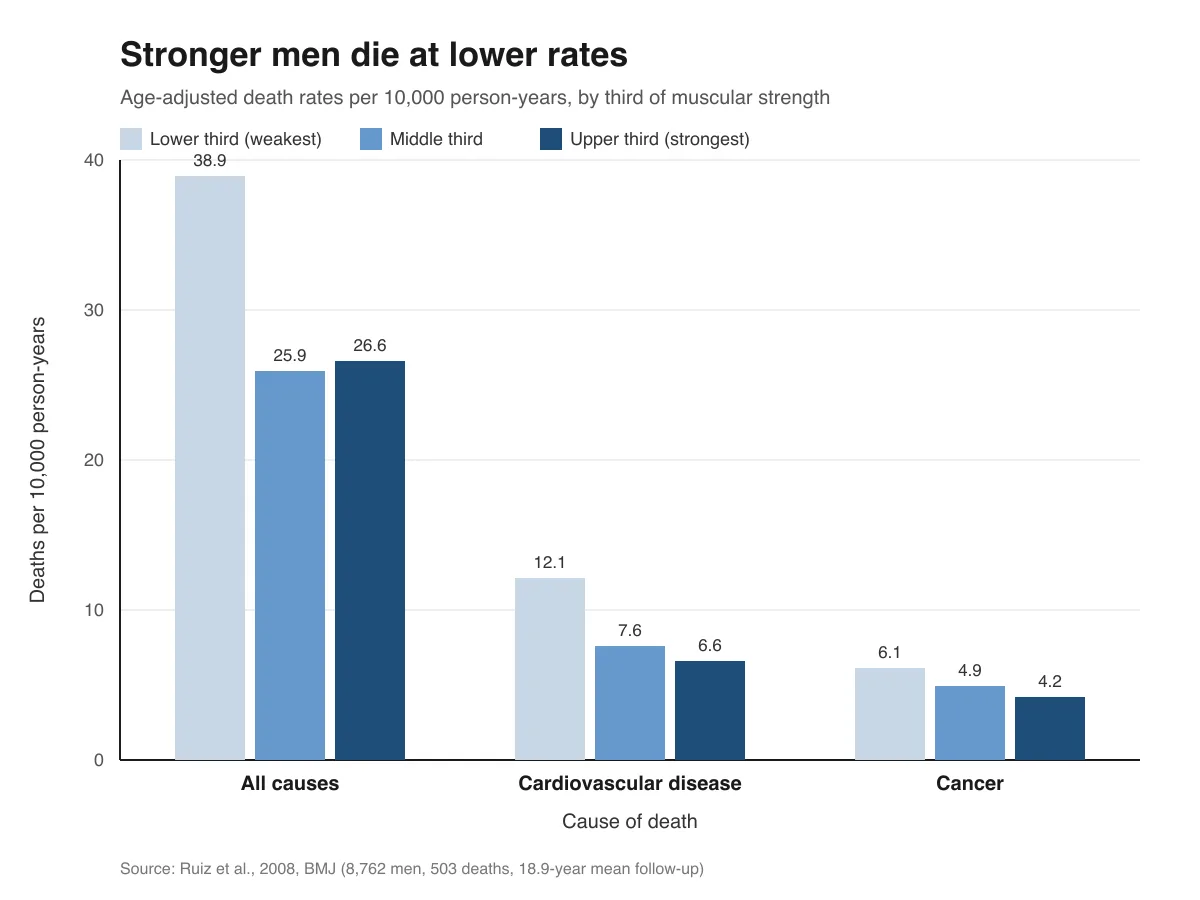
A BMJ cohort study followed 8,762 men for almost 19 years and found that the weakest third by muscular strength died at clearly higher rates from all causes, heart disease, and cancer, even after accounting for cardio fitness (Ruiz et al., 2008).
Why Am I Not Gaining Muscle? The Common Causes
If you train but nothing changes, one of these is almost always the reason:
- Not training with enough resistance; muscle only grows when it is challenged hard.
- Never adding weight or reps, so the body has no reason to grow (no progressive overload).
- Eating too little protein, the raw material muscle is built from.
- Eating too few total calories, so there is no spare energy to build new tissue.
- Poor sleep, which is when most muscle repair actually happens.
- Skipping workouts, so the steady stimulus muscle needs never adds up.
- Switching routines every few weeks before any plan has time to work.
- Training the same muscles too often without rest to rebuild.
- Regular alcohol, which blocks muscle building and disrupts sleep.
- Chronic stress, which keeps cortisol high, a hormone that breaks muscle down.
- Age and naturally lower hormones (like testosterone) make gains slower for some people.
- Doing mostly cardio instead of the weight training muscle actually needs.
- Not tracking workouts or food, so progress is invisible and drifts.
One-Time Setup Before You Start
A few things are worth doing once so the daily habits run smoothly:
-
Join a gym or set up a basic home gym.
-
Pick one structured training program and commit to it for at least 12 weeks.
-
Calculate your maintenance calories and daily protein target with a calculator.
-
Set up a workout log, a Google Sheet is enough:
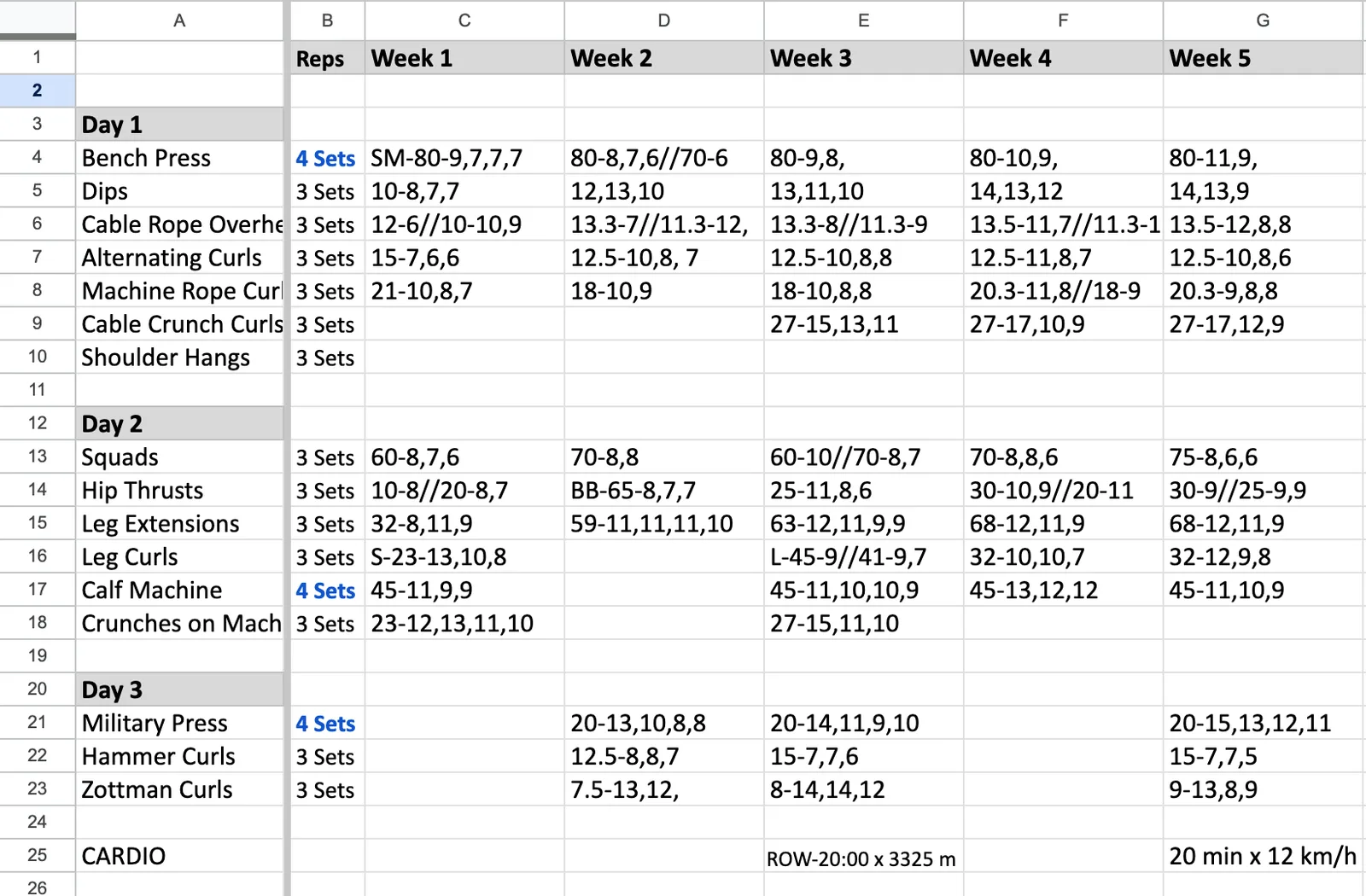
An example of how you could track your workouts.
-
Set up a calorie and macro tracking app.
-
Buy a food scale.
-
Buy a tub of protein powder and creatine monohydrate.
-
Take baseline progress photos and body measurements.
-
Schedule fixed training days into your calendar.
The Muscle Building Habits That Actually Work
Muscle growth stalls for different reasons: some people train too little, others eat too little, others never recover. Find your weak link, then fix it with the habits below.
Activity
HabitLift weights
Warm up, add weight or reps, use a full range of motion
+40
Lift weights
Warm up, add weight or reps, use a full range of motion
Instructions: 1. Warm up with light ramp-up sets before your working weight 2. Build each session around compound lifts (squat, hinge, press, pull), isolation work after 3. Try to add a little weight or one more rep versus last session (progressive overload) 4. Use perfect technique and a full range of motion; lift up with intent, lower slow and controlled 5. Go to failure on your last set 6. Aim for 10 to 20 hard sets per muscle group across the week
Why it may help: Muscle only grows when it is challenged a bit more each time. Compound lifts, controlled full-range reps taken close to failure, and enough weekly sets give every session a reason to produce growth.
HabitLog workout
Write down weight, sets, and reps for every lift
+6
Log workout
Write down weight, sets, and reps for every lift
Instructions: 1. Record each exercise with its weight, sets, and reps 2. Check what you did last session before you start 3. Try to beat one small number each week 4. Beating those numbers little by little is progressive overload, the key to advancing
Why it may help: A written log turns vague effort into visible progress. Knowing exactly what you lifted last time is what makes progressive overload possible.
Mobility
Do mobility drills to keep your joints moving well
Why it may help: A few minutes of mobility work keeps joints moving through their full range, which protects technique on the big lifts and lowers injury risk.
HabitStretch
Stretch for 10 minutes to improve flexibility
+8
Stretch
Stretch for 10 minutes to improve flexibility
Build a quick full-body routine: - Neck and shoulders - Chest and upper back - Hips and hamstrings - Calves and ankles Move gently and stop if something hurts.
Why it may help: Regular stretching keeps muscles supple as they grow, supports full-range technique on the big lifts, and helps you wind down after a session.
Diet
Hit Protein target
Log your protein intake with your fitness app
Why it may help: Protein is the raw material muscle is built from. Hitting a daily target of roughly 1.6 to 2.2 g per kg of bodyweight gives your body everything it needs to repair and grow after training.
Eat daily vegetables
Add a serving of vegetables to fuel your body
Why it may help: Vegetables bring the vitamins, minerals, and fiber that keep digestion, recovery, and overall health working while you eat more food than usual.
HabitCalorie surplus
End the day slightly above maintenance calories
+15
Calorie surplus
End the day slightly above maintenance calories
Instructions: 1. Know your maintenance calories (use a calculator once) 2. Eat about 10 to 20 percent above that number 3. If the scale does not move for two weeks, add a little more
Why it may help: Muscle is new tissue, and building it costs energy. A small surplus gives the body spare fuel to grow without adding much fat.
HabitDrink water
Drink 2 liters of water to stay hydrated
+10
Drink water
Drink 2 liters of water to stay hydrated
Make the target easier to reach: - Drink a glass after waking - Keep a refillable bottle nearby - Drink with each meal
Why it may help: Muscle is mostly water, and even mild dehydration lowers strength and training quality. Steady hydration supports performance and recovery.
HabitHomemade kefir
Ferment milk kefir and eat a portion every day
+12
Homemade kefir
Ferment milk kefir and eat a portion every day
Instructions: 1. Put your kefir grains in a clean glass jar and cover them with about 500 ml of whole milk. 2. Cover the jar with a cloth or a loose lid and leave it at room temperature for 24 hours, away from direct sunlight. 3. Strain the finished kefir through a plastic colander into a glass or bottle. Never use metal, it damages the grains. 4. Put the grains straight into a fresh jar of milk to start the next batch. 5. Enjoy it your way: eat it plain with a spoon, blend it with fruit into a smoothie, pour it over oats or granola, or use it instead of yogurt in a bowl. Benefits: 1. Homemade kefir holds 60 to 110+ different live cultures, while store-bought usually has only 1 to 13. 2. The live cultures crowd out the gut bacteria that produce gas, so bloating and cramping ease off. 3. A balanced gut breaks food down properly, so you absorb more of the nutrients you eat. 4. Most of the immune system sits in the gut wall, so a healthier gut means fewer infections. 5. The gut makes most of the body's serotonin, so a calmer gut supports mood, energy, and sleep. 6. Less gut inflammation often shows on the outside too, in clearer skin.
Why it may help: Kefir adds easy protein and calories and supports the gut, which has to digest a lot of food when you are eating to grow.
Meal prep
Prep your meals for the week
Why it may help: When meals are already made, hitting protein and calorie targets stops depending on daily willpower or time.
HabitWeekly weigh-in
Weigh in once a week, same day, first thing
+5
Weekly weigh-in
Weigh in once a week, same day, first thing
Instructions: 1. Pick one fixed morning per week 2. Weigh yourself before eating or drinking 3. Compare against last week and adjust food if the trend is flat
Why it may help: A weekly morning weigh-in shows whether your surplus is actually working, without the noise of daily fluctuations.
HabitHardgainer snack
Add one calorie-dense snack or shake to your day
+10
Hardgainer snack
Add one calorie-dense snack or shake to your day
Ideas: 1. Smoothie with nuts, heavy cream, MCT oil, or peanut butter 2. Olive oil over meals 3. A handful of nuts 4. Butter in coffee 5. Peanut butter with banana on toast 6. In shakes, use whole milk instead of water and add peanut butter Have it at the same time every day so it becomes automatic. For informational purposes only, not medical advice. Talk to your doctor before starting or changing any treatment.
Why it may help: If you struggle to gain weight, liquid and fat-dense foods add hundreds of calories without making you feel stuffed, which makes the surplus achievable.
HabitGym Supplements
Take creatine, magnesium, and omega 3 every day
+3
Gym Supplements
Take creatine, magnesium, and omega 3 every day
Instructions: 1. Take 5 g of creatine monohydrate once a day 2. Take magnesium in the evening to support sleep and recovery 3. Take a high quality omega 3 (fish oil) with a meal For informational purposes only, not medical advice. Talk to your doctor before starting or changing any treatment.
Why it may help: Creatine is the best-researched muscle supplement and helps you squeeze out extra reps. Magnesium supports sleep and recovery, and omega 3 supports overall health while you train hard.
Recovery
Sleep enough
Get a full 8 hours of sleep tonight
Why it may help: Most muscle repair and growth hormone release happens during sleep. Short nights quietly cancel out hard training.
HabitNo alcohol
Skip alcohol today for a clear, steady head
+38
No alcohol
Skip alcohol today for a clear, steady head
Negative Effects: - Poor sleep - Headaches - Increased anxiety - Digestive problems - Weight gain - Higher blood pressure - Liver damage - Weakened immune system - Higher cancer risk - Risk of dependence - Accidents and injuries - Relationship problems - Expensive nights out - Hangovers - Regrettable decisions
Why it may help: Alcohol interferes with muscle building and wrecks sleep quality, so skipping it protects the gains you worked for.
HabitCold shower
Take a cold shower to boost alertness and resilience
+25
Cold shower
Take a cold shower to boost alertness and resilience
Start gradually: - Finish a normal shower with 15 to 30 seconds of cool water - Keep your breathing slow - Increase the time only when it feels manageable - Stop if you feel dizzy or unwell
Why it may help: A short cold shower wakes the body up, builds discipline, and can ease the feeling of soreness between sessions.
Rewards That Keep You Training
These rewards come from the same product database; spending the coins your habits earn on treats you genuinely want keeps training consistent, and the rest-focused ones even support recovery.
Cheat meal
Eat whatever you want, no rules for this one meal
Why it may help: A planned cheat meal gives you something to train for, adds extra calories, and stops strict eating from turning into burnout.
Sauna session
Sweat it out and relax in the sauna
Why it may help: A relaxed heat session rewards a hard week and helps the body unwind and recover.
RewardMassage gun break
Watch one episode while massage-gunning your muscles
12
Massage gun break
Watch one episode while massage-gunning your muscles
Instructions: 1. Put on one episode of your show 2. Work through sore muscles with the massage gun while you watch 3. Stop after the episode ends
Why it may help: It pairs pure downtime with active muscle recovery, so the treat also eases soreness before the next session.
Favorite snack
Enjoy whichever snack you feel like having
Why it may help: A small planned indulgence keeps the diet sustainable and makes the coins feel worth earning.
Lifting belt
Buy yourself a quality lifting belt
Why it may help: A belt is a treat that feeds back into training, supporting heavier lifts and marking real progress.
New gym bag
Treat yourself to a new gym bag
Why it may help: Fresh gear you like makes going to the gym feel a little more rewarding every single day.
Massage
Book yourself a relaxing massage
Why it may help: A massage releases tension in hard-worked muscles and turns recovery itself into something to look forward to.
Cryotherapy
Book a cryotherapy or ice bath session
Why it may help: A cold session is a memorable treat that can ease soreness and leaves you feeling reset.
Fitness watch
Upgrade to the fitness watch you have been eyeing
Why it may help: A bigger milestone reward keeps long-term motivation alive, and the watch itself feeds back into tracking sleep and activity.