
Hair loss treatment is not one product, it is a routine you repeat every day. This is the full system: why hair loss is worth acting on, what causes it, and how to stop hair loss with habits you can actually track.
Why hair loss is worth taking seriously
Losing hair is extremely common, and the emotional weight it carries is heavier than most people admit:
- About half of men show noticeable balding by age 50, and roughly 80% of white men by age 70.
- It starts young, with around a quarter of men seeing the first signs before they turn 21.
- Women are affected too: about 25% by age 49 and up to 50% by age 65, rising sharply after menopause.
- Around 65% of men with pattern baldness report emotional distress, and more than a quarter find it extremely upsetting.
- Anxiety and depression are the two conditions most often diagnosed alongside hair loss.
- Men at Norwood stage three or higher score on average 6.8 points higher on a standard anxiety scale than men who are not balding.
- Roughly half of sufferers pull back socially, avoiding photos, dating, and situations where their scalp shows.
- Younger adults and women report the worst psychological effects because appearance pressure hits them hardest.
- People spend billions each year on a market crowded with unproven products sold to distressed buyers.
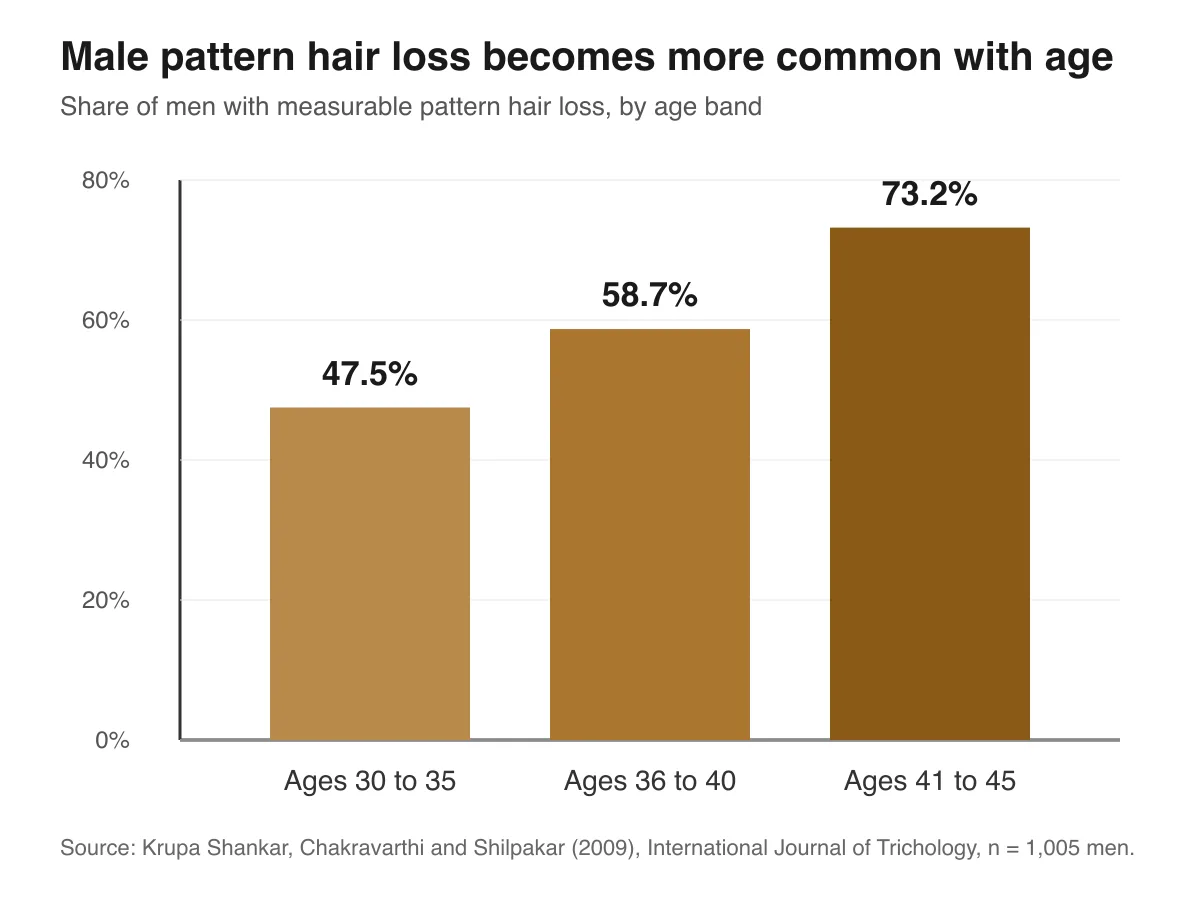
A study that examined and graded 1,005 men aged 30 to 50 found measurable male pattern baldness in 47.5% of men aged 30 to 35, rising to 73.2% of men aged 41 to 45. It shows how common the condition is and how it spreads with age, not what causes it in any one person.
What causes hair loss
Before picking a treatment, it helps to know why your hair is falling out, because the fix depends on the cause:
- Genetics drives most cases by deciding how sensitive your follicles are to DHT, a testosterone by-product that shrinks them until they stop producing visible hair.
- Big shocks like illness, surgery, or major stress push many follicles into resting mode at once, and the shedding shows up two to three months later.
- Hormone shifts after childbirth, during menopause, or from an underactive thyroid disturb the growth cycle and cause diffuse shedding.
- Low iron, vitamin D, zinc, B12, or protein starves the follicles, and crash diets do the same by cutting calories too fast.
- Common medicines including beta blockers, blood thinners, retinoids, and high-dose vitamin A trigger shedding as a side effect.
- Tight braids, ponytails, weaves, and extensions pull hair out at the root, and bleach, dyes, and daily heat make the damage worse until it scars and turns permanent.

The hair loss routine that works
This article is for general information only and is not medical advice. Always talk to a doctor or pharmacist before starting, stopping, or changing any medication, supplement, or treatment.
Hair loss has different causes, so it needs different fixes, and each habit below is one you can track in the app:
HabitTopical treatment
Rub the treatment into your scalp and let it dry
+6
Topical treatment
Rub the treatment into your scalp and let it dry
Instructions: 1. Part your hair so you can reach the skin across the thinning area. 2. Apply your treatment at the strength and frequency you were prescribed, usually once or twice a day. 3. Rub it in with your fingertips, on the scalp and not on the hair. 4. Let it dry fully before a hat or a pillow touches your head. 5. Wash your hands. What is available as a topical: - Minoxidil, the usual starting point, most often 5% at roughly 1 ml per application - Finasteride, sold as a topical solution or combined with minoxidil in one bottle - Dutasteride, the least common of the three and usually compounded to order For informational purposes only, not medical advice. Talk to your doctor before starting or changing any treatment.
Why it may help: A topical goes straight onto the scalp, so it reaches the follicle with far less reaching the rest of your body than a tablet does. Minoxidil widens the small blood vessels feeding the follicle and pushes hairs back into their growing phase, while topical finasteride and dutasteride block the hormone that shrinks it. All of them work while you use them and stop working when you stop, so the daily repetition is the treatment.
HabitHair loss medication
Take your prescribed tablet (min, fin or dut)
+5
Hair loss medication
Take your prescribed tablet (min, fin or dut)
Instructions: 1. Take the medication your doctor prescribed, at the same time each day. 2. Typical prescribed doses are finasteride 1 mg daily, dutasteride 0.5 mg daily or weekly, and low-dose oral minoxidil between 1.25 mg and 2.5 mg. 3. Never set your own dose and never buy these without a prescription. 4. Report side effects to your doctor instead of quietly stopping. For informational purposes only, not medical advice. Talk to your doctor before starting or changing any treatment.
Why it may help: These medicines block the hormone that shrinks your follicles, which is the single biggest driver of pattern hair loss. They are slow, they take months before anything visible happens, and the gains reverse if you stop, so consistency matters more than any other factor.
HabitWash hair gently
Use an anti hair loss shampoo and dry without heat
+5
Wash hair gently
Use an anti hair loss shampoo and dry without heat
Instructions: 1. Wash two or three times a week, not daily, so you do not strip the scalp. 2. Use a shampoo with ketoconazole or caffeine. 3. Work it in with your fingertips instead of scrubbing, then rinse with cool water. 4. Blot your hair dry with the towel instead of rubbing it. 5. Air dry rather than blow drying, and skip the straightener and curling iron. 6. Detangle with a wide-tooth comb.
Why it may help: Wet hair is at its most fragile, and heat, rough towelling, and aggressive combing snap it off before it ever falls out on its own. A ketoconazole or caffeine shampoo also calms the scalp and adds a small amount of anti-DHT action while you are washing anyway.
HabitMassage your scalp
Four minutes of firm fingertip circles across the scalp
+5
Massage your scalp
Four minutes of firm fingertip circles across the scalp
Instructions: 1. Use the pads of your fingers, never your nails. 2. Work in firm circles across the whole scalp for four minutes. 3. Cover the thinning areas and the healthy areas around them. 4. Do it dry, in the shower, or while your topical treatment soaks in.
Why it may help: Sustained daily massage over several months was linked to thicker hair in a small study, most likely by stretching the cells around the follicle and improving blood flow. The evidence is thin, but it costs nothing, carries no risk, and doubles as a stress-reduction moment.
HabitDerma stamping
One or two gentle microneedling sessions a week
+11
Derma stamping
One or two gentle microneedling sessions a week
Instructions: 1. Wash your hair and scalp first so the skin is clean. 2. Rinse the stamp under water, spray it with 70% alcohol, and let it dry completely. 3. Press it straight down across the whole thinning area, lifting between presses instead of dragging. 4. Keep the pressure gentle. No blood should show. Blood means you are pressing far too hard. 5. Leave your topical treatment off for the rest of that day. 6. Do this once or twice a week, never more.
Why it may help: The tiny controlled punctures trigger the skin's repair response and growth signals around the follicle, and the research is strongest when microneedling is paired with minoxidil rather than used alone. Done too hard or too often it damages the scalp instead of stimulating it, which is why the gentle pressure and the weekly limit matter.
HabitUse laser cap
Twenty minutes of red light therapy
+7
Use laser cap
Twenty minutes of red light therapy
Instructions: 1. Use a cap that emits red light in the 650 to 680 nanometre range, since that is what the studies used. 2. Pick an FDA cleared device with enough diodes to cover the whole scalp, not a handful of bulbs. 3. Wear it for 20 minutes on a dry scalp. 4. Run two or three sessions a week. More sessions do not speed anything up.
Why it may help: Red light at this wavelength appears to nudge resting follicles back into their growth phase, and it has moderate evidence behind it as an add-on to minoxidil. It is passive time rather than effort, which makes it easy to keep up once the cap is bought.
HabitApply rosemary oil
Massage diluted rosemary oil into the thinning areas
+5
Apply rosemary oil
Massage diluted rosemary oil into the thinning areas
Instructions: 1. Patch test on your arm first to check you do not react to it. 2. Dilute a few drops of rosemary oil in a carrier oil such as jojoba or coconut. 3. Massage it into the thinning areas. 4. Leave it on for at least 30 minutes, or overnight. 5. Wash it out on your next wash day.
Why it may help: One trial found rosemary oil performed comparably to low-strength minoxidil over six months, though the evidence is much weaker and thinner than for the medications. It is cheap and low risk, so it is a reasonable extra rather than a replacement for treatment that works.
Supplements
Take your daily vitamins and supplements
Why it may help: Low iron, vitamin D, and zinc are among the most common reversible causes of shedding, and correcting a real deficiency can stop the loss entirely. Supplementing something you are not short of does nothing for your hair and wastes money.
HabitEat for your hair
Fruit, veg, protein, water, and eating at maintenance
+15
Eat for your hair
Fruit, veg, protein, water, and eating at maintenance
Instructions: 1. Eat five portions of fruit and vegetables across the day. 2. Get enough protein at every main meal. 3. Drink enough water. 4. Eat at maintenance, roughly the calories you burn, not well above or well below it. 5. If you are losing weight on purpose, aim for a small deficit rather than a steep one. 6. Do not skip meals to make up for a heavy day.
Why it may help: Hair is mostly protein, and it is the first thing your body stops spending energy on when food or nutrients run short. Rapid weight loss is a well-documented trigger for heavy shedding two to three months later, because a sharp calorie drop pushes a large share of follicles into resting mode at once. Eating steadily at maintenance keeps the follicles supplied and avoids that shock entirely.
HabitNo smoking
Stay smoke free today, one day at a time
+45
No smoking
Stay smoke free today, one day at a time
Health risks: - Lung damage - Higher cancer risk - Heart disease - Reduced fitness - Bad breath - Yellow teeth - Premature skin aging - Weaker immune system - Fertility problems - Higher risk of stroke - Secondhand smoke harms others - Higher healthcare costs - Money wasted on cigarettes - Clothes, hair, and home smelling of smoke
Why it may help: Smokers face close to double the risk of balding compared with non-smokers, and smoking narrows the small blood vessels that feed the follicle. It is one of the few lifestyle factors with a measurable link to how fast pattern loss progresses.
HabitNo alcohol
Skip alcohol today for a clear, steady head
+38
No alcohol
Skip alcohol today for a clear, steady head
Negative Effects: - Poor sleep - Headaches - Increased anxiety - Digestive problems - Weight gain - Higher blood pressure - Liver damage - Weakened immune system - Higher cancer risk - Risk of dependence - Accidents and injuries - Relationship problems - Expensive nights out - Hangovers - Regrettable decisions
Why it may help: Heavy drinking interferes with how well you absorb the nutrients hair depends on, particularly zinc and B vitamins, and it wrecks the sleep your body does its repair work in. Cutting it back supports every other habit in this system.