Learning how to meditate properly takes about six instructions and a timer, not a retreat in Bali. Here is the beginner's version: why it's worth doing, the exact steps, and which type of meditation fits which goal.
Key takeaways
 13 minutes a day was enough to improve attention, memory, and mood in one 2019 study.Meditation reduces anxiety about as much as antidepressants do in clinical trials.Noticing your mind wandered and returning to the breath is the exercise, not a failure at it.Pick your technique by goal, not by hype. The comparison table below shows when to use which.
Why meditation is worth your time
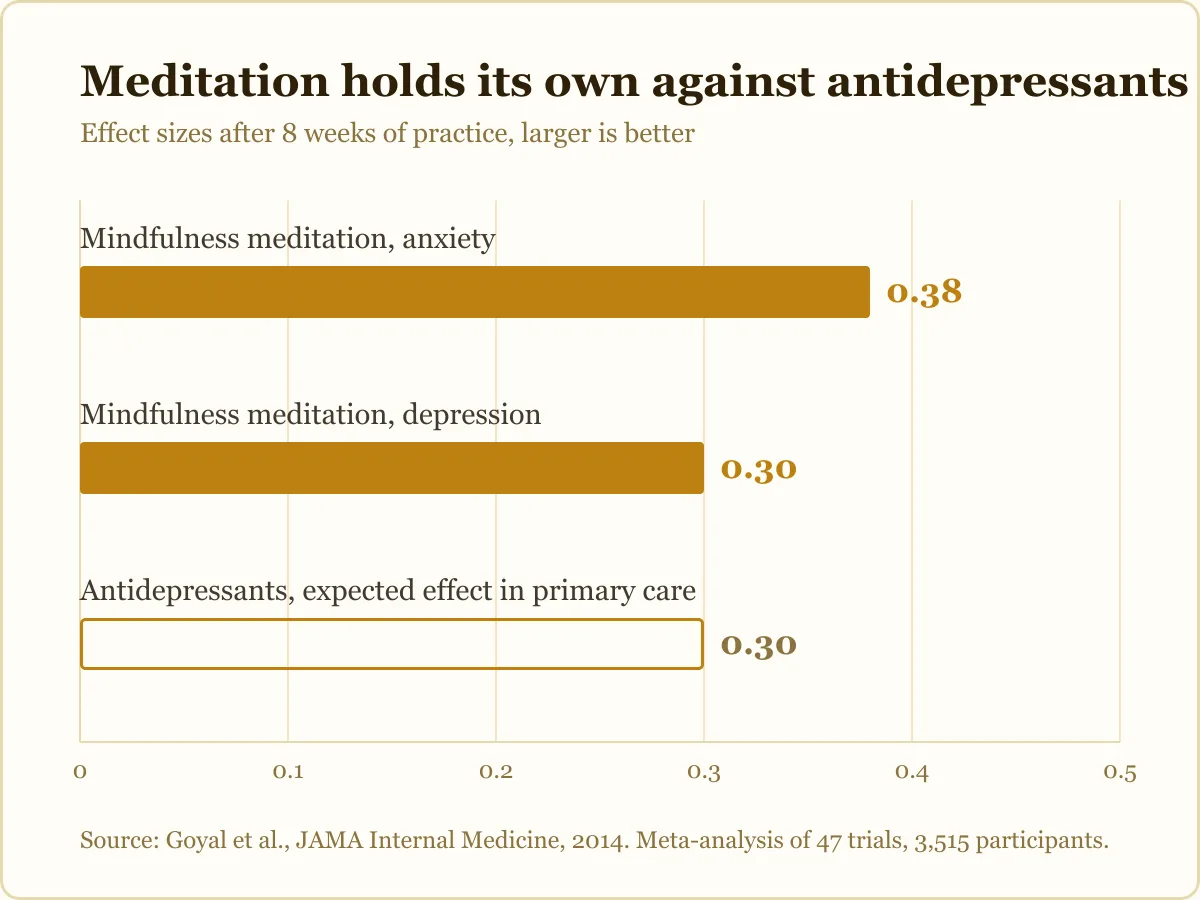
Meditation is one of the few habits with clinical-trial evidence behind the hype. In a Johns Hopkins meta-analysis of 47 trials with 3,515 participants, mindfulness programs improved anxiety with an effect size of 0.38 and depression at 0.30 after eight weeks (Goyal et al., 2014). Those are modest numbers, but they sit in the same range as antidepressants in similar populations, from sitting quietly.
Around 18% of US adults now meditate, roughly 60 million people, more than double the 8% who did in 2002 (NHIS trend analysis, 2024).
The dose is smaller than you'd think. Non-meditators who practiced just 13 minutes a day for eight weeks improved their attention, working memory, and mood (Basso et al., 2019). Even one 10-minute guided session sharpened accuracy on attention tasks in complete novices (Norris et al., 2018).
The benefits reach the body as well. The American Heart Association reviewed the evidence on meditation and cardiovascular risk and concluded that Transcendental Meditation may be considered in clinical practice to lower blood pressure, backed by a body of randomized trials (Levine et al., JAHA, 2017).
One honest caveat: the effects are small to moderate, not miraculous. That's exactly why consistency matters more than any single session. The discipline of showing up daily, not the quality of any one sit, is what turns these numbers into your numbers.
How to meditate properly, step by step
Wondering how to start meditating today? This is the whole method:
- Sit comfortably. A chair is fine. Straight back, hands on your thighs, eyes closed or half open.
- Set a timer for 10 minutes. The timer decides when you're done, so your brain doesn't have to keep checking.
- Anchor on your breath. Follow the air in and out at the nostrils or the belly. Don't control it, just watch it.
- When your mind wanders, notice and return. It will wander, dozens of times. Noticing and coming back is the actual repetition, like a rep in the gym. You didn't fail, you trained.
- End deliberately. When the timer rings, notice one sound and one body sensation before opening your eyes.
- Repeat daily, same time. Consistency at 10 minutes beats an occasional hour.
Anchor it to something you already do. Right after your morning coffee, or right before your shower. A habit glued to an existing routine survives; a habit that floats gets skipped.
HabitMeditate
Meditate for 10 minutes using Headspace
+25
Meditate
Meditate for 10 minutes using Headspace
Benefits: - Lowers stress - Reduces anxiety - Sharpens focus - Increases self-awareness - Lowers blood pressure - Improves sleep quality - Decreases inflammation - Enhances memory
The most common types of meditation, explained
How do you meditate correctly when there are a dozen schools? By picking one technique and giving it a fair run. These seven cover almost everything a beginner will meet.
Mindfulness (breath awareness)
The default and the most researched form. Most of the anxiety and attention evidence above comes from this style, so if you don't know where to begin meditation, begin here.
- Set up. Sit on a chair or cushion, back upright but not rigid, hands resting on your thighs. Close your eyes or lower your gaze to the floor. Set a timer for 10 minutes.
- Settle in. Take three slow, deliberate breaths. After the third, stop steering the breath and let it run at whatever pace it wants.
- Choose one anchor point. Notice where the breath feels most vivid: the air at your nostrils, your chest rising, or your belly expanding. Pick that one spot and stay with it for the whole session.
- Follow each breath. Track the full inhale, the small pause, and the full exhale. If it helps, count breaths from 1 to 10, then start over. Lost count? Start again at 1, no penalty.
- When the mind wanders, come back. You will drift into plans, memories, and nonsense dozens of times. The moment you notice, gently return to the anchor. That return is the rep, so twenty wanderings means twenty reps, not twenty failures.
- End on purpose. When the timer rings, notice one sound in the room and one sensation in your body before opening your eyes.
Free guide. UCLA Mindful's free guided meditations include a 5-minute breathing meditation recorded by the research center's director, with transcripts and Spanish versions of several sessions.
HabitMindful Breathing
Follow your natural breathing for 10 minutes
+30
Mindful Breathing
Follow your natural breathing for 10 minutes
How to practise: - Sit comfortably and set a timer for 10 minutes. - Take three slow breaths, then let your breathing return to normal. - Choose one anchor, such as your nostrils, chest or belly. - Observe each inhale and exhale without controlling them. - When your mind wanders, notice it and gently return to the breath. - When the timer rings, notice one sound and one body sensation before opening your eyes.
Deep belly breathing
Unlike mindfulness, deep belly breathing deliberately slows and deepens each breath. It is a quick way to settle your body when you feel tense, anxious, or unable to sleep.
- Sit or lie down comfortably and place one hand on your chest and the other on your belly.
- Breathe in slowly through your nose. Let your belly rise while keeping your upper chest as still as you comfortably can.
- Exhale gently through your mouth and feel your belly fall.
- Keep your shoulders and jaw relaxed. Never force the breath or take in more air than feels comfortable.
- Repeat for 2 to 5 minutes. If you feel dizzy, return to normal breathing and stop.
The aim is not to take the biggest breath possible. It is to let the diaphragm do more of the work so each breath feels slow, quiet, and comfortable.
HabitDeep Belly Breathing
5 minutes of deep belly breathing
+6
Deep Belly Breathing
5 minutes of deep belly breathing
Deep belly breathing: - Breathe in slowly through your nose, letting your belly rise. - Exhale gently through your mouth and repeat for 2 to 5 minutes. Benefits: - reduce stress - calm the nervous system - improve focus - make it easier to fall asleep - help with stomach ache
Body scan
You move attention slowly through the body, noticing tension and letting it soften. It works lying down, which makes it a natural pre-sleep wind-down.
- Lie down or sit. Lie on your back with arms at your sides, or sit with both feet flat on the floor. Close your eyes and set a timer for 15 minutes (10 works too).
- Arrive first. Spend about 30 seconds feeling the points where your body presses into the floor or chair, then take three slow breaths.
- Start at the toes. Bring attention to the toes of one foot and hunt for any sensation: warmth, pressure, tingling, the fabric of a sock. Finding nothing is also an observation. Note "nothing" and move on.
- Sweep upward, one region at a time. Feet, calves, knees, thighs, hips, lower back, belly, chest, hands, arms, shoulders, neck, jaw, face, scalp. Give each region roughly 20 to 30 seconds.
- Breathe into tension. Where you find tightness (jaw and shoulders are the classics), imagine the breath flowing into that spot and let it soften on the exhale. If it won't release, note it and keep moving. Never force it.
- Finish whole. Feel the entire body at once for a final minute, wiggle your fingers and toes, then open your eyes. If you did this in bed and fell asleep around step 4, that was the plan.
Free guide. Berkeley's Greater Good in Action body scan has a full written script plus guided audio, and the UCLA library above includes a 13-minute body scan made for falling asleep.
Loving-kindness (metta)
You silently repeat phrases of goodwill, first for yourself, then for others. It feels awkward for a week, then it starts blunting self-criticism and irritability in a way breath work doesn't.
- Sit and settle. Sit comfortably, close your eyes, take three slow breaths. Some people rest a hand on their chest; skip that if it feels silly.
- Start with yourself. Picture yourself as you are right now. Repeat slowly, about one phrase per out-breath: "May I be well. May I be at ease. May I be safe." Stay here 2 to 3 minutes. It will feel wooden at first. Say the words anyway, the feeling catches up later.
- Move to someone you love. Picture a person (or a pet) who is easy to feel warmth for, and switch to "May you be well. May you be at ease. May you be safe." Another 2 to 3 minutes.
- Then a neutral person. The barista, a neighbor, someone you see often but never think about. Same phrases, same pace.
- Then, when you're ready, someone difficult. Start with mildly annoying, not your worst enemy. If this step is too much in week one, skip it and add it back later.
- Close with everyone. Widen out to all of it: "May all of us be well." Sit for a few more breaths, then open your eyes.
Free guides. Berkeley's Greater Good in Action loving-kindness practice is a research-backed script with audio, and Tara Brach's free metta meditation is a gentle 12-minute guided version.
Guided meditation
A recording or app talks you through the session. It's the lowest barrier to entry there is, and the 10-minute novice study above used exactly this format. The training wheels are the point; you can drop them later.
- Pick one app and stick with it for a month. Insight Timer has the biggest free library, Headspace the best structured beginner courses.
- Choose a 10-minute beginner session. Earphones in, phone face down, sit or lie somewhere you won't be interrupted.
- Follow the voice. Your only job is to come back when you drift. The narrator handles everything else.
- Use the same series daily. Working through one course beats sampling a new teacher every day. When the sessions start feeling easy, that's your cue to try 10 unguided minutes with a plain timer.
Walking meditation
Meditation for people who can't sit still: attention goes to the steps instead of the breath. Useful as a reset during the workday, and a legitimate practice in its own right.
- Find your lane. A quiet stretch of 10 to 20 meters: a hallway, a garden path, an empty stretch of park. You'll walk back and forth, so it doesn't need to lead anywhere.
- Stand still for 30 seconds. Before the first step, feel your feet on the ground and your weight balancing over them.
- Walk at half speed. Noticeably slower than normal, hands relaxed at your sides or clasped behind your back. Slow enough that you can feel the mechanics of every step.
- Track each step in three parts. Lifting the foot, moving it forward, placing it down. Silently labeling "lifting, moving, placing" keeps the mind on task.
- Turn deliberately. At the end of your lane, stop, take one full breath, turn around, and continue.
- Do 10 minutes. When the mind wanders, return attention to the soles of your feet. Same rule as the breath: the return is the rep.
Free guides. Berkeley's Greater Good in Action walking meditation breaks down the exact foot mechanics, and Mindful.org's guided walking meditation adapts the practice to normal-speed daily walks.
Transcendental Meditation
A mantra-based technique practiced 20 minutes twice a day. It's distinct enough, and searched enough, to earn its own section right below.
How to do Transcendental Meditation
Transcendental Meditation, or TM, means sitting with eyes closed for 20 minutes twice a day while silently repeating a mantra. The defining instruction is effortlessness: you don't concentrate on the mantra or push thoughts away, you let the sound repeat and fade on its own.
Here is the practice, step by step:
- Sit comfortably with back support, hands in your lap, and close your eyes.
- Wait about 30 seconds, just settling.
- Begin repeating your mantra silently, at whatever rhythm feels natural.
- Don't concentrate. When thoughts arrive, let them pass and ease back to the mantra without effort.
- If the mantra fades into silence, that's the technique working. Let it.
- After 20 minutes, stop the mantra and sit quietly for 2 minutes before opening your eyes.
- Repeat once in the morning and once in the late afternoon.
Common mantras. In the official program a teacher assigns you a personal mantra, but classic Sanskrit meditation mantras work on the same principle. Widely used ones include "Om", "So Ham" (silently "so" on the inhale, "ham" on the exhale), "Shirim", "Aham Prema", and "Om Shanti". What matters is that the sound is soft, meaningless to you in daily life, and comfortable to repeat.
Apps for mantra meditation. 1 Giant Mind teaches a free 12-step mantra technique very close in spirit to TM and is the best starting point. Insight Timer has thousands of free guided mantra sessions plus a plain timer for silent practice.
Where to learn the official technique. Certified instruction is available through tm.org, taught in person over about four sessions. The taught course is where the blood pressure evidence the American Heart Association reviewed in 2017 comes from, so if the cardiovascular benefit is your goal, learning it properly is worth considering. For everyone else, the free mantra route above captures much of what the technique does.
HabitTM Meditation
Practise 20 min transcendental meditation with a mantra
+50
TM Meditation
Practise 20 min transcendental meditation with a mantra
How to practise: - Sit comfortably with back support and close your eyes. - Wait about 30 seconds and let your body settle. - Silently repeat a mantra at a natural rhythm. - Do not force your attention or suppress thoughts. - When your mind wanders, return gently to the mantra. - If the mantra becomes quieter or disappears, allow it. - After 20 minutes, stop repeating it and sit quietly for another 2 minutes. - Practise once in the morning and once in the late afternoon. Three common mantra examples are "Om", "So Ham" and "Om Shanti". Official Transcendental Meditation assigns a personal mantra through a certified teacher.
Why it may help: Repeating one mantra gives a restless mind a single thing to hold, which is what lets it settle without you managing your breath. Doing it at the same two times every day turns calming down into a routine rather than a fight.
Which meditation should you use? A comparison
| Type | Best for | Session | Beginner-friendly? |
|---|---|---|---|
| Mindfulness (breath) | Anxiety, focus, general default | 10 to 15 min | Yes |
| Deep belly breathing | Fast calming, tension, sleep | 2 to 5 min | Yes |
| Body scan | Physical tension, falling asleep | 10 to 30 min | Yes, works lying down |
| Loving-kindness | Self-criticism, low mood, anger | 10 to 15 min | Yes, feels odd at first |
| Guided | Absolute beginners, restarting | 5 to 20 min | The easiest entry point |
| Walking | Restlessness, workday resets | 10 to 20 min | Yes |
| Transcendental (TM) | Blood pressure, deep-rest seekers | 20 min, twice | Yes, free via mantra apps |
If you're unsure, start with guided or plain mindfulness for eight weeks, then specialize once you know what you're solving for.
FAQ
The research is clear that meditation pays off after weeks of daily practice, and that's exactly what most people never reach. Spend Your Habits pays you coins for every session and tracks the streak, so day 43 feels as rewarding as day 1.